
The Ultimate Guide to High SEER AC vs Standard SEER

Is a High SEER AC Worth It in the Midwest? Here's What Ohio Homeowners Need to Know
When weighing high SEER AC vs standard SEER in Midwest four season climates, the short answer is: it depends on how long you plan to stay in your home, your current energy bills, and the condition of your insulation and ductwork. Here is a quick breakdown to help you decide at a glance:
| Factor | Standard SEER (13.4–15 SEER2) | High SEER (16–20+ SEER2) |
|---|---|---|
| Upfront cost | Lower | Higher |
| Annual energy savings | Baseline | 13–43% more efficient |
| Best for Midwest cooling season | Short-term owners | Long-term owners |
| Humidity control | Basic | Significantly better |
| Noise level | Higher | Quieter |
| Federal tax credit eligible | Generally no | Yes (16 SEER2+) |
| Typical payback period (Ohio) | N/A | 8–15 years |
If you are a Central Ohio homeowner shopping for a new air conditioner, you have probably stared at quotes for different efficiency levels and wondered whether the upgrade is actually worth it. Ohio summers are real — hot, humid, and unpredictable — but they are also shorter than what homeowners in the South deal with. That shorter cooling season changes the math on energy savings in ways that a lot of national guides simply do not account for.
Understanding the difference between a standard and a high-efficiency system in a true four-season climate like Columbus or the surrounding communities is not just about picking the biggest number on the label. It is about matching the right technology to your home, your habits, and your budget — and knowing what the SEER2 rating on that new unit actually means in the real world.
Understanding SEER and SEER2 in the Midwest
If you’ve lived in Central Ohio for a while, you know our weather has a bit of an identity crisis. We can go from a crisp 50-degree spring morning to a muggy 90-degree afternoon in what feels like minutes. To manage these swings efficiently, the HVAC industry uses a rating system called SEER, which stands for Seasonal Energy Efficiency Ratio.
Think of SEER like the MPG rating on your car. It measures how much cooling output a system provides for every watt of electricity it consumes over an entire season. However, as of January 1, 2023, the Department of Energy (DOE) updated these standards to a new metric called SEER2.
Why the Change to SEER2?
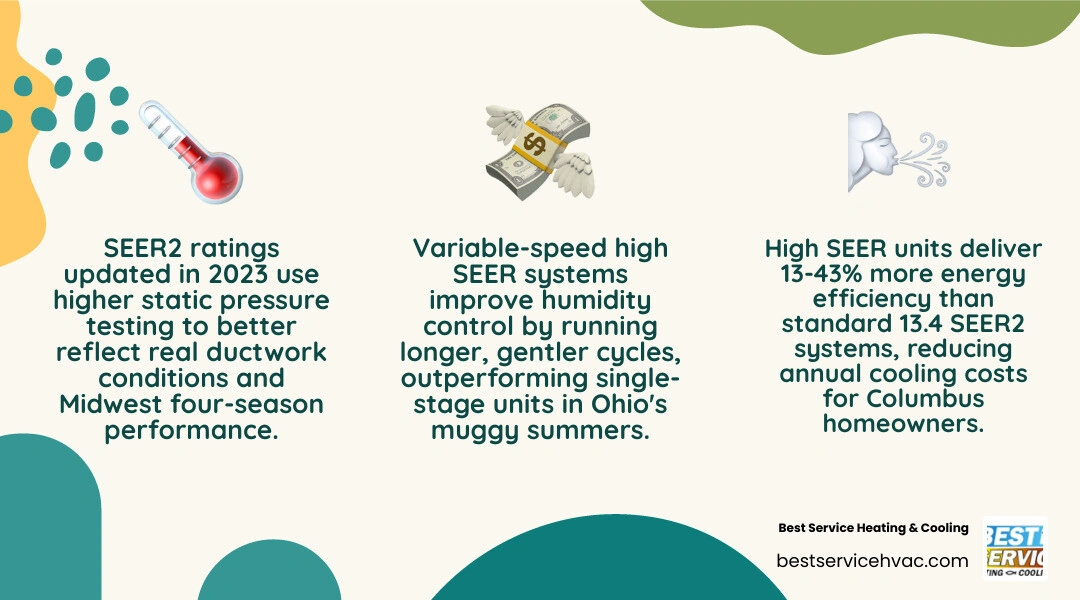
The original SEER testing was done in a laboratory environment that didn't always match how homes in places like Reynoldsburg or Westerville are actually built. The new M1 testing procedure for SEER2 uses higher external static pressure. This is a fancy way of saying they now test the units as if they are actually connected to real-world ductwork, which creates more resistance than a lab bench.
Because the testing is more rigorous, a SEER2 rating is typically about 4.5% lower than its old SEER equivalent. For example, a unit that was once called a 14 SEER is now roughly a 13.4 SEER2. Whether you are looking for AC for Residential or Light Commercial use, understanding this shift is the first step in making an informed purchase.
High SEER AC vs Standard SEER in Midwest Four Season Climates: Understanding the Ratings
In our "North" region (which includes Ohio), the federal minimum for a new central air conditioner is 13.4 SEER2. This is what we consider "standard efficiency." It’s a reliable, entry-level option that gets the job done.
On the other hand, "high-efficiency" units typically start at 16 SEER2 and can soar to 20 or even 25 SEER2.
- Standard Efficiency (13.4–15 SEER2): Usually features single-stage compressors (it’s either 100% on or 100% off).
- High Efficiency (16–18 SEER2): Often utilizes two-stage compressors, which have a "high" and "low" setting.
- Ultra-High Efficiency (20+ SEER2): Uses variable-speed technology, which acts like a dimmer switch for your cooling, adjusting in tiny increments to match your home's needs exactly.
How Cooling Season Length Affects Value
This is where the Midwest four-season reality kicks in. In the South, air conditioners might run for six to eight months out of the year. In Columbus, our heavy cooling season usually lasts about four months—roughly from late May through September.
Because our units run fewer hours annually, the "payback period" (the time it takes for energy savings to cover the higher upfront cost of the unit) is longer here than in Florida or Arizona. However, that doesn't mean high efficiency isn't worth it. With electricity rates rising, a unit that is 20% to 40% more efficient can still save you hundreds of dollars every year. Plus, as we'll discuss, efficiency isn't just about the bill—it's about how comfortable you feel while watching a Buckeyes game in July. To ensure that efficiency lasts, the Benefits of Regular HVAC Maintenance in Midwest Four-Season climates cannot be overstated; a dirty high-SEER unit can quickly perform like a standard one.
Performance Factors: Comfort, Humidity, and Noise

When comparing high SEER AC vs standard SEER in Midwest four season environments, most people focus solely on the math. But we spend a lot of time in our homes, and "comfort" is a huge part of the ROI.
Standard systems are like a light switch. When the temperature hits 74 degrees, the AC kicks on at full blast. Once it hits 72, it shuts off. This leads to "temperature swings"—you’re cold, then you’re warm, then you’re cold again. High-efficiency systems, especially those designed for Light Commercial Air Conditioning and Heating Columbus OH or larger residential homes, solve this with staged cooling.
Why High SEER AC vs Standard SEER in Midwest Four Season Homes Impacts Summer Comfort
The biggest enemy of Ohio comfort isn't just the heat; it's the humidity. Standard single-stage units often cool the house so quickly that they don't run long enough to pull the moisture out of the air. This leaves you feeling "clammy" or "muggy" even if the thermometer says 72.
High-efficiency units offer:
- Superior Humidity Control: Because two-stage and variable-speed units run longer cycles at a lower capacity, they act like a giant dehumidifier. They constantly pull moisture out of the air, allowing you to feel comfortable even at a higher thermostat setting.
- Whisper-Quiet Operation: Standard units make a loud "thump" and a roar when they kick on. High-SEER units start up gradually and often run at decibel levels so low you won't even notice they are on while you're sitting on your patio in Dublin or Powell.
- Consistent Airflow: By running more consistently, these systems prevent "hot spots" in two-story homes, ensuring the upstairs bedrooms stay just as cool as the living room.
Is a High SEER AC vs Standard SEER in Midwest Four Season Regions Worth the Investment?
Deciding whether to go "high" or "standard" often comes down to your long-term plans. If you are flipping a house in Linden or planning to move out of your Hilliard starter home in two years, a standard 13.4 SEER2 unit is a smart, economical choice. It provides reliable cooling without a large upfront investment that you won't live long enough to recoup.
However, if this is your "forever home" in New Albany or Pickerington, the high-SEER investment starts to look much better.
| Feature | Single-Stage (Standard) | Two-Stage (High) | Variable-Speed (Ultra-High) |
|---|---|---|---|
| Efficiency | Baseline | High (+12-15%) | Max (+20-40%) |
| Humidity Removal | Fair | Great | Excellent |
| Noise Level | Moderate | Quiet | Ultra-Quiet |
| Life Expectancy | 15 Years | 15-20 Years | 15-20 Years |
Beyond the monthly bill, there is the environmental impact. A more efficient unit reduces your carbon footprint, which is a growing priority for many Central Ohio families. For those looking for a Custom AC for Light Commercial setup, the savings are amplified because the cooling loads are much higher.
External Factors Influencing Actual Savings
A high SEER rating is just a sticker on a box until it’s installed in your home. Your actual savings depend on:
- Ductwork Integrity: If your ducts are leaking air into your attic or crawlspace, a 20 SEER2 unit won't save you much more than a 14 SEER2 unit.
- Insulation: If your attic insulation is thin, the heat will soak into your home faster than any AC can keep up with.
- System Sizing: This is critical. We always perform a Manual J load calculation. If a unit is too big, it will "short cycle" (turn on and off too fast), ruining its efficiency. If it's too small, it will run forever and never cool the house.
Incentives and Financial Benefits for Ohio Homeowners
One of the biggest "game changers" for the high SEER AC vs standard SEER in Midwest four season debate is the current landscape of incentives. In May 2026, we are still seeing the massive benefits of the Inflation Reduction Act.
Federal Tax Credits (25C)
Under current federal law, homeowners can claim a tax credit of up to $600 for qualifying high-efficiency central air conditioners. To qualify, systems generally need to meet or exceed 16 SEER2. If you opt for a high-efficiency heat pump instead of a traditional AC, that credit can jump up to $2,000. This significantly lowers the "effective cost" of upgrading to a premium system.
Local Utility Rebates
Utility providers across Central Ohio—from Amlin to Canal Winchester—often offer their own rebates to encourage energy conservation. These can range from $100 to $500 depending on the SEER2 rating of the unit you install. When you combine a federal tax credit with a local utility rebate, the price gap between a standard unit and a high-efficiency unit shrinks considerably.
Frequently Asked Questions about AC Efficiency
What is the difference between SEER and SEER2?
SEER2 is the new national standard that replaced SEER in 2023. The primary difference is the testing method. SEER2 tests equipment under higher static pressure to better simulate the "real world" resistance of a home's ductwork. This results in a more accurate (though numerically lower) rating.
Does a high SEER rating help with Midwest humidity?
Absolutely. High SEER systems typically use two-stage or variable-speed compressors. These units run longer, slower cycles. Instead of a quick blast of cold air, they provide a steady, gentle flow that gives the evaporator coil more time to pull moisture out of the air. This is a lifesaver during those "sticky" August nights in Columbus.
Is it worth upgrading if I plan to move in five years?
If your primary goal is financial ROI, a standard efficiency unit (13.4 to 15 SEER2) is often the better choice for a five-year window. The energy savings from a high-SEER unit usually take 8 to 12 years to fully pay back the initial price difference. However, a high-efficiency system can be a strong selling point that increases your home's resale value.
How do I find my current AC's SEER rating?
You can usually find it on the yellow "EnergyGuide" sticker on the side of your outdoor condenser. If that's faded or missing, look for the model number on the manufacturer's plate and search for it online, or give us a call—we can look it up for you in seconds.
Conclusion
Choosing between high SEER AC vs standard SEER in Midwest four season climates doesn't have to be a headache. Whether you prioritize the lowest possible upfront cost or the highest possible long-term comfort and savings, there is a "sweet spot" for every home.
At Best Service Heating & Cooling, we’ve been helping our neighbors in Reynoldsburg, Columbus, and the surrounding areas stay comfortable since 1992. As a family-owned business with an A+ BBB rating, we don't believe in high-pressure sales. We believe in providing the facts, performing precise Manual J calculations, and ensuring your new system is installed perfectly so it actually hits those rated efficiency numbers.
Ready to see which SEER2 rating makes the most sense for your home and budget? Schedule your high-efficiency cooling consultation today and let us help you find the perfect balance of comfort and value.
.webp)
.webp)

Service Areas
