
Cheat Sheet to How Much a Tankless Water Heater Saves per Year

Is a Tankless Water Heater Worth It? Here's What Central Ohio Homeowners Need to Know
How much does a tankless water heater save per year is one of the most common questions homeowners ask before making the switch — and the answer depends on a few key factors. Here's a quick breakdown:
| Water Heater Type | Estimated Annual Savings vs. Traditional Tank |
|---|---|
| Gas tankless (average) | ~$108/year |
| Electric tankless (average) | ~$44/year |
| ENERGY STAR condensing gas tankless | ~$95/year (family of 4) |
| High-efficiency condensing models | Up to $124/year |
Water heating is the second largest energy expense in most U.S. homes. According to the U.S. Department of Energy, the average household spends roughly 13% of its total energy budget just heating water. For Central Ohio homeowners already watching utility bills climb, that's a significant chunk worth paying attention to.
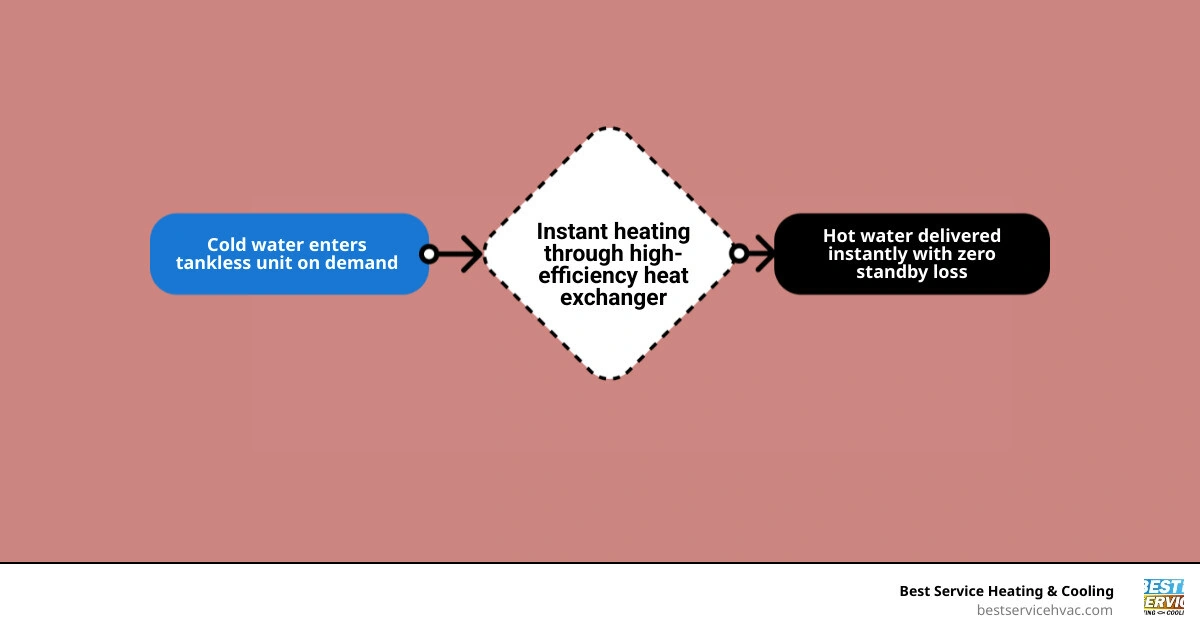
Tankless water heaters work differently than traditional storage tanks. Instead of keeping 40-50 gallons of water hot around the clock — burning energy even when nobody's home — tankless units heat water only when you turn on the tap. That difference alone eliminates what experts call "standby heat loss," which accounts for 15-25% of a traditional tank's total energy use.
The result? Real, measurable savings every year. But how much you actually save depends on your household size, how much hot water you use daily, whether you have gas or electric service, and how well the unit is maintained over time.
This guide breaks it all down so you can make a confident, informed decision.
Understanding Energy Efficiency: How Much Does a Tankless Water Heater Save per Year?
To truly grasp how a tankless system cuts down on utility bills, we have to look at the physics of heating water. Traditional tank water heaters are constantly fighting standby heat loss. Imagine leaving your car idling in the driveway all day long just in case you need to run to the grocery store in the evening. That is essentially what a standard storage tank does. It continuously fires up to keep dozens of gallons of water at a set temperature (usually 120°F to 140°F), regardless of whether you are asleep, at work, or away on vacation.
When comparing a Traditional vs Tankless Water Heater for Home, the difference in energy conservation becomes clear. Tankless water heaters use a powerful heat exchanger to warm water instantly as it flows through the unit. When you turn off the hot water tap, the unit shuts down completely.
This on-demand process is measured by the Uniform Energy Factor (UEF). The UEF is the modern standard used by the Department of Energy to rate water heater efficiency:
- Standard Storage Tanks: Typically carry a UEF rating between 0.59 and 0.67. This means only 59% to 67% of the energy consumed is actually converted into hot water; the rest is lost to standby heat transfer and exhaust.
- Non-Condensing Tankless Heaters: Usually achieve a UEF of 0.82 to 0.88.
- Condensing Tankless Heaters: Can reach an incredible UEF of 0.90 to 0.97. These high-efficiency systems use dual stainless steel heat exchangers to capture extra heat from the exhaust gases, converting up to 97% of the fuel into usable hot water.
According to data from the U.S. Department of Energy, this massive leap in efficiency translates directly to reduced energy consumption:
- For homes using 41 gallons or less of hot water daily, tankless water heaters can be 24% to 34% more energy efficient than conventional storage tanks.
- For larger households using around 86 gallons per day, they remain 8% to 14% more energy efficient.
- On average, replacing a standard natural draft storage tank with an on-demand model yields a 37% savings in water heating energy per household.

Key Factors That Determine Your Annual Utility Savings
No two households use water exactly the same way, meaning how much does a tankless water heater save per year will vary from one home to the next. Several key variables shape your final utility bills:
- Household Size and Usage Patterns: A single professional living in a small condo in Grandview will have vastly different hot water demands than a family of five in Dublin. Paradoxically, while smaller households enjoy the highest percentage of energy efficiency (up to 34%), larger households often see greater absolute dollar savings because their baseline hot water consumption is so much higher.
- Utility Rates: The cost of natural gas and electricity in Central Ohio fluctuates. Because gas-fired models generally offer higher flow rates and lower operating costs compared to electric models, your choice of fuel plays a huge role in your monthly utility bills.
- Groundwater Temperature: The colder the water entering your home, the harder your system has to work to bring it to a comfortable showering temperature. This is especially relevant in our region, where winters can bring freezing temperatures.
Understanding How Water Heater Installation Can Save You money requires looking closely at these factors before deciding on a system type.
Sizing and Flow Rates: How Much Does a Tankless Water Heater Save per Year for Large Families?
For larger families, the appeal of a tankless water heater goes beyond just the energy bill. The primary benefit is often the endless supply of hot water. No more cold showers because someone else took a long bath or ran the washing machine.
However, managing simultaneous usage is crucial. Tankless water heaters are rated by flow rate, measured in Gallons per Minute (GPM). A typical tankless unit can deliver between 2 and 5 GPM. If your household has high peak demands—such as running a dishwasher, a washing machine, and two showers at the same time—a single small unit might struggle to keep up.
When evaluating Factors When Replacing Your Old Water Heater, sizing is critical. If a system is undersized, you may experience a "cold water sandwich" (a temporary drop in water temperature when multiple taps are opened). To prevent this, larger families often choose high-capacity condensing models or install multiple point-of-use units near high-demand appliances to maximize both comfort and savings.
Climate and Groundwater: How Much Does a Tankless Water Heater Save per Year in Cold Climates?
Geography plays a silent but significant role in water heating efficiency. In Central Ohio, our groundwater temperatures can drop to the low 40s during the peak of winter.
To deliver a comfortable 120°F shower, a water heater must achieve a "temperature rise" of roughly 75°F to 80°F. Because a tankless unit must heat this freezing groundwater instantly as it flows, its output GPM will naturally decrease during the coldest months.
In milder climates like Texas, a tankless system doesn't have to work nearly as hard. For our neighbors in Columbus, Westerville, and Worthington, choosing a robust, professionally sized gas-fired tankless system ensures that winter weather won't compromise your hot water supply or your annual energy savings.
Lifespan and Long-Term Financial Benefits
When assessing the financial return of a home improvement project, looking only at the first year of utility savings doesn't tell the whole story. You must look at the entire lifecycle of the equipment.
A traditional storage tank water heater has a relatively short life expectancy, typically lasting only 10 to 15 years (and often failing sooner in areas with hard water). Over time, sediment builds up at the bottom of the tank, acting as a barrier between the burner and the water, which forces the system to work harder and decreases its efficiency. Eventually, the tank's protective anode rod degrades, leading to rust, corrosion, and the inevitable risk of a costly tank rupture.
In contrast, when exploring How Long Does a Tankless Water Heater Last, you'll find that these systems regularly last 20 to 25 years or more with basic maintenance. Because they do not store water, they aren't subject to the same constant corrosive forces as storage tanks. Furthermore, almost every component inside a tankless unit is modular and easily replaceable, meaning a technician can swap out a single part rather than replacing the entire appliance.
Over a 20-year period, a homeowner with a traditional tank will likely have to purchase and install two separate units. A homeowner who invests in a tankless system will only need to buy one. This longevity makes a compelling case for a long-term Ultimate Water Heater Replacement Columbus OH plan.
Additionally, tankless water heaters can boost your home's resale value. Modern homebuyers value energy-efficient upgrades. Real estate studies indicate that high-efficiency green features can increase a home’s selling appeal, helping properties sell faster and potentially adding to the overall home value.
Maximizing Savings with Proper Maintenance and Installation
To keep your tankless water heater operating at peak efficiency and protect your investment, routine care is essential.
The biggest threat to a tankless unit's efficiency is mineral scale. Central Ohio groundwater contains minerals like calcium and magnesium. When water is heated, these minerals crystallize and cling to the copper or stainless steel heat exchanger inside your unit. Over time, even a thin layer of scale can act as an insulator, forcing the burner to run longer and hotter to heat the same amount of water, which slowly erodes your annual energy savings.
To prevent this, follow these core Maintenance Tips for Tankless Water Heaters:
- Annual Flushing: Flush the heat exchanger with a food-grade descaling solution or virgin white vinegar once a year to dissolve mineral buildup.
- Inlet Filter Cleaning: Regularly inspect and clean the water inlet screen to maintain proper flow rates.
- Water Softening: If your water hardness exceeds 7 grains per gallon, installing a water softener can protect your water heater and extend its lifespan.
Understanding Why Regular Water Heater Service is Important will keep your utility bills low and ensure your system runs smoothly.
Equally important is professional installation. Retrofitting a tankless unit is rarely a simple "plug-and-play" task. Gas units require proper venting through walls using specialized Category III stainless steel or PVC materials, and they often require larger gas lines to handle the high BTU demand when firing up.
Following professional Tips for Water Heater Installation Projects ensures your system is installed safely, satisfies local building codes in Columbus, and qualifies for manufacturer warranty coverage.
Tax Credits, Rebates, and Environmental Impact
To make the transition to clean energy more accessible, federal and local incentives are available to help offset the cost of upgrading to high-efficiency systems.
Under the federal Energy Efficient Home Improvement Credit (Section 25C), homeowners can claim a tax credit of up to $600 for qualified ENERGY STAR certified gas tankless water heaters. These incentives make upgrading highly attractive for those looking to lower their carbon footprint.
Beyond the immediate financial perks, the environmental benefits of tankless systems are substantial. Because they burn fuel only when hot water is actively needed, they significantly reduce greenhouse gas emissions. In fact, if every household in the country transitioned to ENERGY STAR certified gas tankless models, it would prevent billions of pounds of annual greenhouse gas emissions—the equivalent of removing hundreds of thousands of vehicles from the road.
If you are planning an upgrade, reviewing a Water Heater Installation Reynoldsburg Guide can help you navigate local permit requirements and identify utility rebates available in your specific Central Ohio neighborhood.
Frequently Asked Questions About Tankless Water Heater Savings
What is the payback period for a tankless water heater?
The payback period—the time it takes for your annual utility savings to offset the initial installation premium—typically ranges from 6 to 12 years. However, this timeline can be shortened significantly by taking advantage of federal tax credits, local utility rebates, and avoiding the cost of a mid-lifecycle tank replacement. For homeowners planning to stay in their homes long-term, the investment pays off well within the system's 20+ year lifespan. If you're planning a replacement, exploring options for the Best Water Heater Replacement Downtown Columbus can help you find a system that fits your budget and long-term financial goals.
Do tankless water heaters require special venting or electrical upgrades?
Yes, in many retrofit scenarios, infrastructure upgrades are necessary. Gas tankless units require specialized venting to safely exhaust combustion gases, and because they burn gas at a higher rate when active, they may require upgrading your gas line from a 1/2-inch to a 3/4-inch pipe. Electric models, on the other hand, demand significant electrical current and may require an upgrade to a 200-amp electrical panel. Recognizing when your Tankless Water Heater is About to Break Down or planning these upgrades during a home renovation can help you avoid unexpected installation challenges.
How do energy efficiency ratings (UEF) differ between tankless and tank models?
The Uniform Energy Factor (UEF) measures the overall water heating efficiency of an appliance. Standard storage tank models usually have UEF ratings between 0.59 and 0.67 due to constant standby heat loss. Non-condensing tankless models improve on this with UEF ratings between 0.82 and 0.88, while premium condensing tankless models achieve UEF ratings of 0.90 to 0.97 by recycling heat from their exhaust gases.
Conclusion
Upgrading to a tankless water heater is a smart way to lower your annual utility bills, secure an endless supply of hot water, and make a long-term investment in your home's infrastructure. While the upfront installation requires careful planning, the combination of energy savings, extended equipment lifespan, and reduced environmental impact makes it a highly rewarding upgrade for many Central Ohio families.
Since 1992, Best Service Heating & Cooling has provided reliable, high-quality home comfort solutions across Columbus, Reynoldsburg, Westerville, and the surrounding communities. As a family-owned business with an A+ BBB rating, our trained technicians are here to help you find the perfect water heating system for your home and budget.
Ready to start saving on your energy bills? Schedule your professional water heater consultation with Best Service Heating & Cooling today!
.webp)
.webp)

Service Areas
