
Best Smart Thermostat Schedule for Midwest Four-Season Weather: Complete Guide

Why the Best Smart Thermostat Schedule for Midwest Four-Season Weather Can Cut Your Energy Bills All Year
Finding the best smart thermostat schedule for Midwest four-season weather is one of the most impactful things a Central Ohio homeowner can do to control comfort and energy costs — because heating and cooling account for roughly 52% of the average household's energy bill. And in the Midwest, that challenge is harder than most places. Columbus and the surrounding region don't just have two seasons — they have four distinct ones, plus the notoriously unpredictable in-between weeks of spring and fall when temperatures can swing 30 degrees in a single day.
Here's a quick-reference guide to the recommended smart thermostat settings for each Midwest season:
| Season | At Home | Sleeping | Away from Home |
|---|---|---|---|
| Winter | 68°F | 62–65°F | 60–62°F |
| Spring/Fall | Heat: 68°F / Cool: 73°F | 62–65°F | 62°F (use auto-changeover) |
| Summer | 78°F | 65–67°F | 85–88°F |
| Vacation (Winter) | - | - | 55°F minimum |
| Vacation (Summer) | - | - | 85°F maximum |
Shifting your thermostat just 7–10 degrees for eight hours a day can reduce your annual heating and cooling costs by up to 10%, according to the U.S. Department of Energy. A smart thermostat makes that happen automatically — but only if it's programmed correctly for how Midwest weather actually behaves.
This guide walks Central Ohio homeowners through exactly how to build a seasonal schedule that works, season by season, lifestyle by lifestyle, and HVAC system by HVAC system.
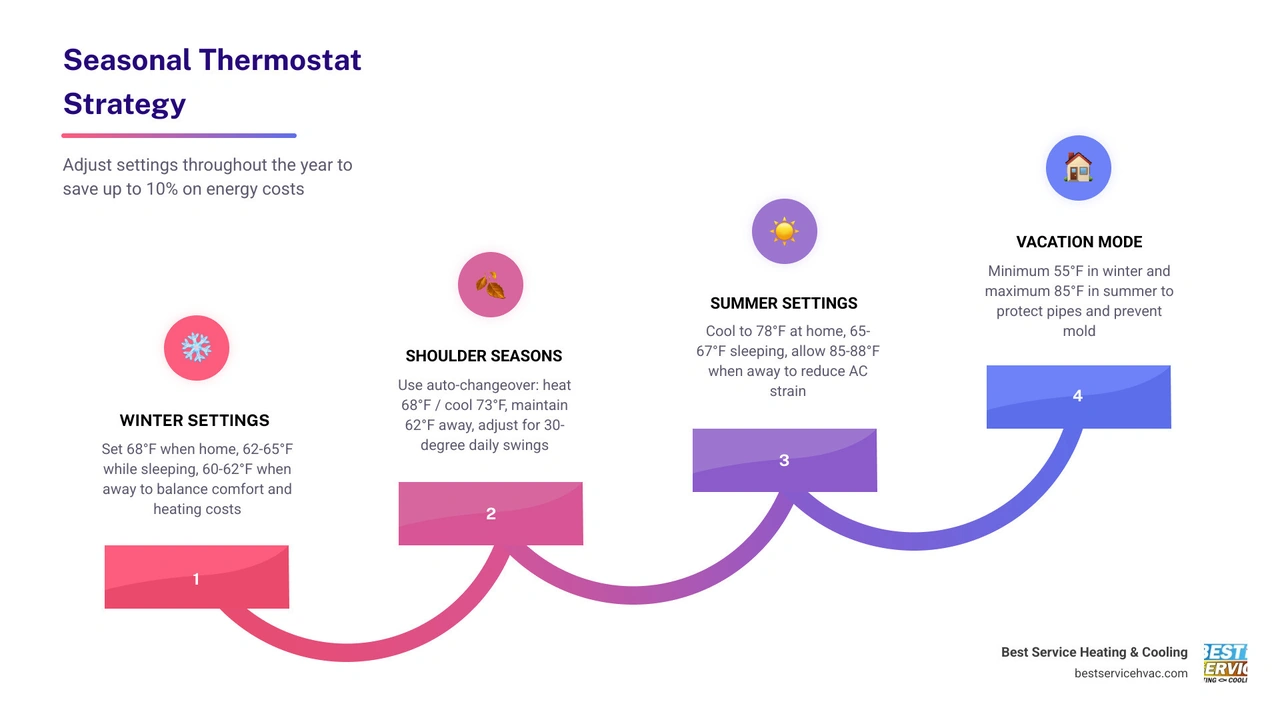
Optimizing Your Home with the Best Smart Thermostat Schedule for Midwest Four Season Weather
To get the most out of Smart Thermostats Columbus OH, we must move beyond the "set it and forget it" mentality. In Central Ohio, leaving your thermostat at a single temperature year-round is a recipe for high energy bills and unnecessary strain on your HVAC system. By understanding how to align your smart thermostat settings with our local climate, you can achieve the perfect balance of comfort and efficiency.
The general rule of thumb for maximum energy savings is to target a winter indoor temperature of 68°F when you are awake and home, and a summer indoor temperature of 78°F. While 78°F might sound warm to some, it represents an optimal midpoint that keeps your home significantly cooler than the outdoor summer heat without forcing your air conditioner to run continuously.
When you go to sleep or leave the house, adjusting these baselines by 7 to 10 degrees is where the real savings happen. Every degree you set back your thermostat for an eight-hour period can save you roughly 1% on your energy costs. Over a full year of changing seasons in places like Dublin, Westerville, and Reynoldsburg, these small, automated adjustments add up to roughly 10% annual savings on your heating and cooling runtime.
Summer and Winter Settings for the Best Smart Thermostat Schedule for Midwest Four Season Weather
Let's look closer at how to manage the two extreme seasons in Central Ohio: winter and summer.
Winter Settings (The Heating Season)
During our cold, snowy winters, the goal is to keep your home warm enough to protect your family and your plumbing while minimizing heat loss through walls and windows.
- When Home and Awake: Set your thermostat to 68°F. This is warm enough for indoor comfort, especially if you dress in comfortable layers.
- When Sleeping: Lower the thermostat to 62°F–65°F. Studies show that cooler ambient temperatures promote deeper, healthier sleep. Plus, heavy blankets make up for the lower temperature.
- When Away: Drop the temperature to 60°F–62°F.
Summer Settings (The Cooling Season)
When summer humidity rolls into the Scioto River valley, your air conditioner has to work double-time to remove both heat and moisture from the air.
- When Home and Awake: Target 78°F. To make this setting feel much cooler, we highly recommend using ceiling fans. Running a ceiling fan creates a wind-chill effect that makes the room feel 3 to 4 degrees cooler than it actually is, allowing you to keep the thermostat higher without sacrificing comfort. Just remember: fans cool people, not rooms, so turn them off when you leave.
- When Sleeping: Drop the temperature to 65°F–67°F. This is often necessary for sleep comfort during humid summer nights.
- When Away: Raise the thermostat to 85°F–88°F.
If you are currently running an older, less efficient heating and cooling setup, these setbacks are even more critical to keep your monthly bills manageable. To see how upgrading your system affects these dynamics, check out our guide on Standard vs High Efficiency HVAC Comparison.
Weekday vs. Weekend Routines for the Best Smart Thermostat Schedule for Midwest Four Season Weather
A static schedule doesn't work because our lives change when the weekend arrives. Most modern smart thermostats allow you to set a 5-2 schedule (one schedule for weekdays, one for weekends) or a fully customized 7-day schedule. To maximize your savings, we recommend organizing your days into a standard 4-block schedule: Wake, Away, Return, and Sleep.
The 9-to-5 Commuter Template
If you leave the home for work every weekday, your smart thermostat schedule should reflect those empty hours:
- Wake (6:00 AM – 8:00 AM): 68°F in winter / 76°F in summer.
- Away (8:00 AM – 5:00 PM): 60°F in winter / 85°F in summer.
- Return (5:00 PM – 10:00 PM): 68°F in winter / 78°F in summer.
- Sleep (10:00 PM – 6:00 AM): 62°F in winter / 67°F in summer.
The Work-From-Home (WFH) Template
If you work from home in Grove City or New Albany, you can't use deep daytime setbacks. However, you can still save by implementing a "light" setback during your most active working hours when you are moving around and drinking warm beverages:
- Wake/Work (8:00 AM – 5:00 PM): 66°F–67°F in winter / 78°F in summer.
- Evening (5:00 PM – 10:00 PM): 68°F in winter / 77°F in summer.
- Sleep (10:00 PM – 8:00 AM): 62°F in winter / 67°F in summer.
Weekend Adjustments
On weekends, your home is likely occupied for most of the day. You should program your thermostat to maintain your "Home" comfort settings throughout the daytime hours, but don't forget to let the temperature drift during the overnight sleeping block.
By automating these schedules, you ensure your heating and cooling systems only run at full capacity when you actually need them. To learn more about how much you can trim from your utility bills with a modern setup, read our article on How Much Does a High Efficiency System Save.
Managing Unpredictable Midwest Shoulder Seasons (Spring and Fall)

If you've lived in Central Ohio for long, you know that spring and autumn are beautifully volatile. It is not uncommon to scrape frost off your windshield in the morning at 30°F, only to run your car's air conditioning on the way home when it hits 72°F. This constant shifting puts an incredible amount of stress on your home's comfort systems.
To manage these dramatic transitions without constantly walking to the wall to adjust your thermostat, you need to master two key smart thermostat features: Auto-Changeover and Deadband Settings.
Auto-changeover allows your thermostat to automatically switch between heating and cooling modes based on the indoor temperature. However, to prevent your furnace and air conditioner from "fighting" each other (which wastes energy and can damage the compressor), you must set an appropriate deadband.
A deadband is a temperature buffer zone where neither heating nor cooling will turn on. We recommend setting a deadband of at least 3 to 5 degrees. For example, if you set your target heating temperature to 68°F and your target cooling temperature to 73°F, your HVAC system will remain completely idle as long as your indoor temperature stays within that comfortable 5-degree window.
Another common spring and fall issue is indoor humidity. High humidity can make a 65°F home feel raw, damp, and chilly, while also encouraging mold growth in hidden areas. To combat this, keep your HVAC fan set to Auto rather than On. When the fan is set to "On," it runs continuously, which can re-evaporate moisture off your cooling coils and blow it back into your home. The "Auto" setting ensures the fan only runs during a cycle, allowing condensation to drain away safely. For more information on preventing moisture issues, read about How Proper HVAC Maintenance Prevents Mold Growth.
Smart Thermostat Features for Transitional Weather
Modern smart thermostats come equipped with advanced features that are uniquely suited to the chaotic weather patterns of the Midwest.
- Geofencing: This feature uses your smartphone's GPS location to determine if you are home or away. When you cross a virtual boundary (for example, driving 3 miles away from your house in Hilliard or Gahanna), the thermostat automatically switches to your energy-saving "Away" settings. When you cross back into that boundary, the system begins conditioning your home so it is comfortable by the time you pull into the driveway. This is perfect for busy families with irregular schedules.
- Adaptive Learning: Premium smart thermostats observe your daily habits and temperature preferences. Over a couple of weeks, they build a personalized schedule for you, automatically lowering the temperature when they know you've gone to bed or left for work.
- Remote Sensors: Many homes in older Columbus neighborhoods, like Clintonville or German Village, suffer from uneven temperatures between floors. Remote sensors can be placed in your bedroom or home office, telling the thermostat to prioritize the temperature of the room you are actually occupying rather than the hallway where the main thermostat is mounted.
Utilizing these smart features is a great step toward optimizing your home's energy footprint. Additionally, you may qualify for local financial incentives to help offset the cost of upgrading your system. Learn more about these opportunities in our guide to Ohio Energy Rebates for HVAC Upgrades.
Heat Pump vs. Traditional HVAC Scheduling in the Midwest
Heat pumps have grown immensely in popularity across Central Ohio because they are incredibly efficient at transferring heat rather than generating it. However, heat pumps require a completely different scheduling strategy than traditional gas furnaces. If you program a heat pump the same way you program a furnace, you could accidentally cause your energy bills to skyrocket.
Traditional gas furnaces produce high-temperature heat quickly. If you lower your furnace thermostat by 8 degrees while you are at work, the furnace can easily recover those 8 degrees in a short amount of time when you return.
Heat pumps, on the other hand, operate on a "slow and steady" principle. They are highly efficient at maintaining a constant temperature, but they struggle to raise temperatures quickly when there is a large gap between the room temperature and the thermostat setting. When a heat pump detects a temperature deficit of more than 2 to 3 degrees, it will often trigger its Auxiliary Heat (AUX). Auxiliary heat typically consists of electric resistance coils (similar to a giant toaster inside your ductwork). While highly effective at producing instant heat, auxiliary heat is incredibly expensive to run.
To prevent your system from relying on expensive backup heat, you must limit your winter thermostat setbacks. For a heat pump, never set the temperature back by more than 1 to 3 degrees.
To help illustrate these differences, here is a comparison of how to schedule setbacks based on your system type:
| HVAC System Type | Recommended Winter Setback | Recovery Strategy |
|---|---|---|
| Gas/Electric Furnace | 5°F to 10°F | Rapid recovery is fine; system handles large temperature jumps efficiently. |
| Air-Source Heat Pump | 1°F to 3°F maximum | Must use "Smart Recovery" or "Adaptive Recovery" to warm the home gradually. |
| Boiler / Radiant Heat | 2°F to 4°F | Slow-response system; program recovery to start 2 to 3 hours before you arrive home. |
To make sure your heat pump recovers efficiently, make sure to enable features like "Smart Recovery," "Adaptive Intelligent Recovery," or "True Radiant" in your thermostat's settings. These algorithms learn how long your home takes to warm up and will start the heat pump early, running it at its most efficient stage to reach your target temperature right on time without turning on the auxiliary heat. Understanding these nuances is key to managing your home's energy. You can learn more about how different systems are graded for efficiency by reading Efficiency Ratings Explained for Homeowners.
Avoiding Costly Heat Pump Mistakes in Cold Weather
One of the most common mistakes we see homeowners make during Central Ohio cold snaps is "cranking" the thermostat up to 75°F because they feel cold. This does not heat your home any faster; instead, it simply forces the system to run its expensive auxiliary heat continuously to try and meet that extreme target.
Additionally, you should ensure your thermostat's auxiliary lockout temperature is set correctly. This setting prevents the backup electric heat from turning on unless the outdoor temperature drops below a certain threshold (usually around 30°F, depending on your home's insulation and heat pump model). If this lockout is set too high, your system will use auxiliary heat even on mild winter days.
Because heat pumps are complex systems that operate year-round, keeping them clean and well-maintained is absolutely vital to ensuring they run efficiently. To find out if a professional check-up is right for your system, read Annual HVAC Maintenance Is It Worth It.
Frequently Asked Questions about Midwest Thermostat Settings
What is the best temperature to set my thermostat when away on vacation in the Midwest?
When you are leaving your Central Ohio home for an extended vacation, you want to save as much energy as possible without putting your home at risk.
In the winter, never set your thermostat below 55°F. While you might be tempted to turn the heat off completely, doing so can allow the temperature inside your walls to drop below freezing, leading to burst pipes and catastrophic water damage. Keeping the thermostat at 55°F ensures warm air continues to circulate through your utility areas.
In the summer, set your vacation temperature to 85°F. Do not turn the air conditioner off completely. In the humid Midwest, an air conditioner is vital for controlling indoor moisture. If your home's humidity level rises above 60% for an extended period, you run a high risk of returning home to find mold and mildew growing on your drywall, furniture, and carpets. Keeping your AC active at 85°F allows it to cycle occasionally, removing excess moisture from the air.
To ensure your system is up to the task of running reliably while you are away, it helps to understand the ideal service intervals. Check out our guide on How Often Should You Service Your HVAC.
Does pre-cooling or pre-heating actually save money during peak hours?
Yes, if your local utility provider uses "Time-of-Use" (TOU) pricing where electricity is more expensive during peak afternoon hours.
To take advantage of this, you can use your home's "thermal mass"—the ability of your home's structure, drywall, and furniture to store heat.
- In the Summer: Program your smart thermostat to "pre-cool" your home to 72°F during the late morning when electricity rates are low. Once the peak afternoon pricing begins, set your thermostat to "drift" up to 78°F. Because your home was pre-cooled, your air conditioner won't need to run nearly as much during those expensive peak hours.
- In the Winter: Pre-heat your home slightly in the early morning hours before the peak demand period begins, then let the temperature drift down slightly during peak times.
This strategy works best in well-insulated homes that can hold their temperature for several hours. To ensure your system is operating at peak efficiency so you can maximize these savings, read more about Why Schedule Routine Home HVAC Service.
How do smart thermostat schedules impact home value and energy bills?
Properly configured smart thermostat schedules can slash your heating and cooling runtime, lowering your monthly energy bills by up to 10% annually. Over several years, these savings easily pay back the initial cost of the smart thermostat.
Beyond direct energy savings, smart home upgrades are highly attractive to modern home buyers in Central Ohio. Buyers appreciate seeing upgraded, energy-efficient technology already installed, which can make your property stand out in competitive real estate markets like Powell, Upper Arlington, or Worthington. To explore how larger comfort upgrades can benefit your home's long-term worth, read How a New HVAC System Increases Home Value.
Conclusion
Mastering the best smart thermostat schedule for Midwest four-season weather is one of the smartest moves you can make as a homeowner. By aligning your heating and cooling schedules with our local climate, utilizing advanced features like auto-changeover and geofencing, and avoiding common heat pump scheduling mistakes, you can enjoy a perfectly comfortable home while keeping your utility bills as low as possible.
Since 1992, Best Service Heating & Cooling has provided top-rated residential HVAC services across Columbus, Ohio and surrounding communities. As a family-owned business with an A+ BBB rating, we are dedicated to helping our neighbors find affordable, reliable, and energy-efficient comfort solutions. Whether you need professional smart thermostat installation, a seasonal system tune-up, or a comprehensive comfort plan, our trained technicians are here to help.
Ready to take complete control of your home's comfort and efficiency? Sign up for our comprehensive service agreement membership plan today, or contact us to schedule your smart thermostat consultation!
.webp)
.webp)

Service Areas
