
Counting the Coins: Energy Savings from High Efficiency Equipment

How Much Does a High Efficiency System Save Central Ohio Homeowners?
How much does a high efficiency system save is one of the most common questions homeowners ask before committing to an upgrade — and for good reason. Heating and cooling account for nearly half of the average household's annual energy bill. That's a significant chunk of money that a more efficient system could keep in your pocket.
Here's a quick snapshot of real-world savings you can expect:
| Upgrade | Estimated Annual Savings |
|---|---|
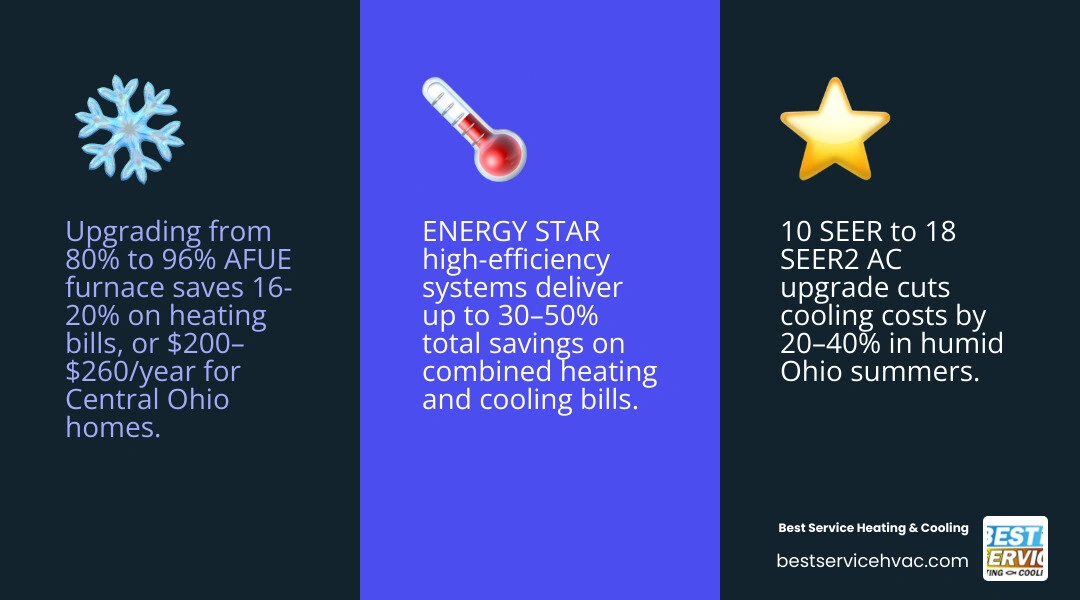
| 10 SEER → 18 SEER2 (AC) | 20–40% on cooling costs |
| 80% → 96% AFUE (furnace) | 16–20% on heating bills (~$200–$260/year) |
| 14 SEER2 → 18 SEER2 (AC) | ~28% less electricity used |
| Aging system → ENERGY STAR unit | Up to 30–50% on combined heating & cooling |
| Hot climate AC upgrade | Up to ~$230/year saved |
| Northern/moderate climate AC upgrade | ~$80–$100/year saved |
Those numbers are real, but they come with an important caveat: your actual savings depend on your home, your climate, and how your system is installed and maintained. A high-efficiency rating on a box doesn't automatically translate to a lower bill if the ductwork is leaking or the unit is sized wrong.
For Central Ohio homeowners in Columbus, Dublin, Westerville, and surrounding communities, the math is worth doing carefully. Ohio winters are genuinely cold — cold enough that furnace efficiency gains add up fast. Summers are humid and warm enough to make AC efficiency count too. That puts Central Ohio residents in a strong position to benefit from high-efficiency upgrades on both sides of the equation.
The sections below walk you through exactly how to calculate your potential savings, what factors push those numbers up or down, and how to figure out whether an upgrade makes financial sense for your specific situation.
Understanding High-Efficiency HVAC Ratings in Central Ohio
When we talk about efficiency, we aren't just using a marketing buzzword. In the HVAC world, efficiency is a measurable science. As of April 2026, the standards for what qualifies as "high-efficiency" have evolved, thanks to Department of Energy (DOE) updates and the transition to SEER2.
SEER2 (Seasonal Energy Efficiency Ratio 2)
This is the yardstick for your air conditioner or the cooling side of your heat pump. It measures how much cooling the system puts out for every unit of electricity it consumes. The "2" in SEER2 refers to updated testing protocols that better reflect real-world conditions, like the static pressure found in typical home ductwork. In our region, a system rated at 16 SEER2 or higher is generally considered high-efficiency, with premium units reaching 20+ SEER2.
AFUE (Annual Fuel Utilization Efficiency)
This rating applies to gas furnaces. Think of it as "cents on the dollar." An 80% AFUE furnace—which was the standard for decades—converts 80 cents of every dollar spent on gas into usable heat, while 20 cents literally goes up the chimney. A high-efficiency furnace (90% to 98% AFUE) uses a secondary heat exchanger to capture that waste heat. When you choose a 96% AFUE unit, you’re only losing 4 cents of every dollar.
HSPF2 (Heating Seasonal Performance Factor 2)
For those of us in Columbus using heat pumps, HSPF2 measures heating efficiency over a full season. With modern "cold climate" heat pumps, these ratings have skyrocketed, allowing systems to provide 100% of your home's heat even when temperatures drop toward 30°F.
ENERGY STAR Certification
When you see the ENERGY STAR label, it means the unit has been independently certified to save energy and money while protecting the environment. For example, an ENERGY STAR qualified furnace is typically 15% more efficient than a conventional model.

How much does a high efficiency system save on monthly bills?
The most immediate impact of an upgrade is the drop in your monthly utility statement. If your current system was installed 15 to 20 years ago, it was likely a 10 SEER AC and an 80% AFUE furnace. Upgrading to modern equipment can cut your heating and cooling bills by 30% to 50%.
To put this in perspective, let’s look at how electricity consumption changes based on efficiency tiers:
| Efficiency Tier | Estimated Energy Consumption | Potential Savings vs. Base |
|---|---|---|
| 14 SEER2 (Standard) | High Baseline | 0% |
| 18 SEER2 (High) | ~28% Less Electricity | ~28% |
| 22 SEER2 (Ultra-High) | ~44% Less Electricity | ~44% |
How much does a high efficiency system save in terms of actual electricity? A high-efficiency AC doesn't just run better; it starts better. Standard units can require up to 6,000 watts just to kick the compressor into gear. High-efficiency models with variable-speed technology use significantly less startup wattage and run longer, lower cycles, which is much cheaper than the constant on-and-off "surges" of older units.
How much does a high efficiency system save in the Ohio climate?
In Central Ohio, we experience a wide range of "Heating Degree Days." From October through March, our furnaces are the workhorses of the home. Because we spend so much time in heating mode, the jump from a 70% or 80% AFUE furnace to a 95% or 96% model can net you 14% to 18% in fuel savings annually.
In the summer, our biggest challenge isn't just the heat—it’s the humidity. High-efficiency air conditioners are superior at dehumidification. By running longer, lower-speed cycles, they pull more moisture out of the air. When the humidity is lower, you feel cooler at 74°F than you would at 70°F in a "sticky" house. This allows you to set your thermostat higher, saving 6% to 10% on your bill for every degree you raise it.
For residents in specific areas, we’ve put together local insights like our Best Furnace Service Dublin Oh Guide and the Best Boiler Tune Up Guide Downtown Columbus Oh to help you understand how local weather patterns affect your equipment choices.
How much does a high efficiency system save when paired with smart tech?
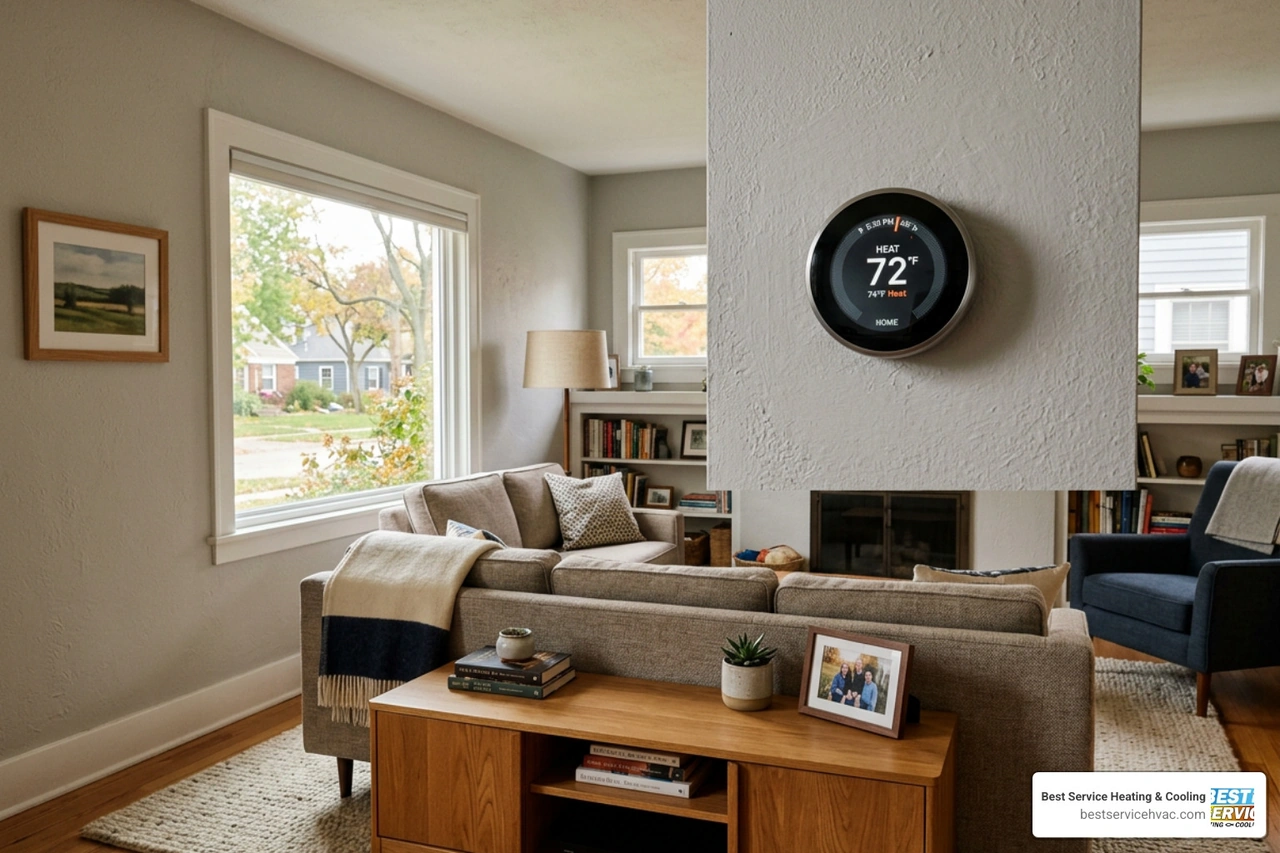
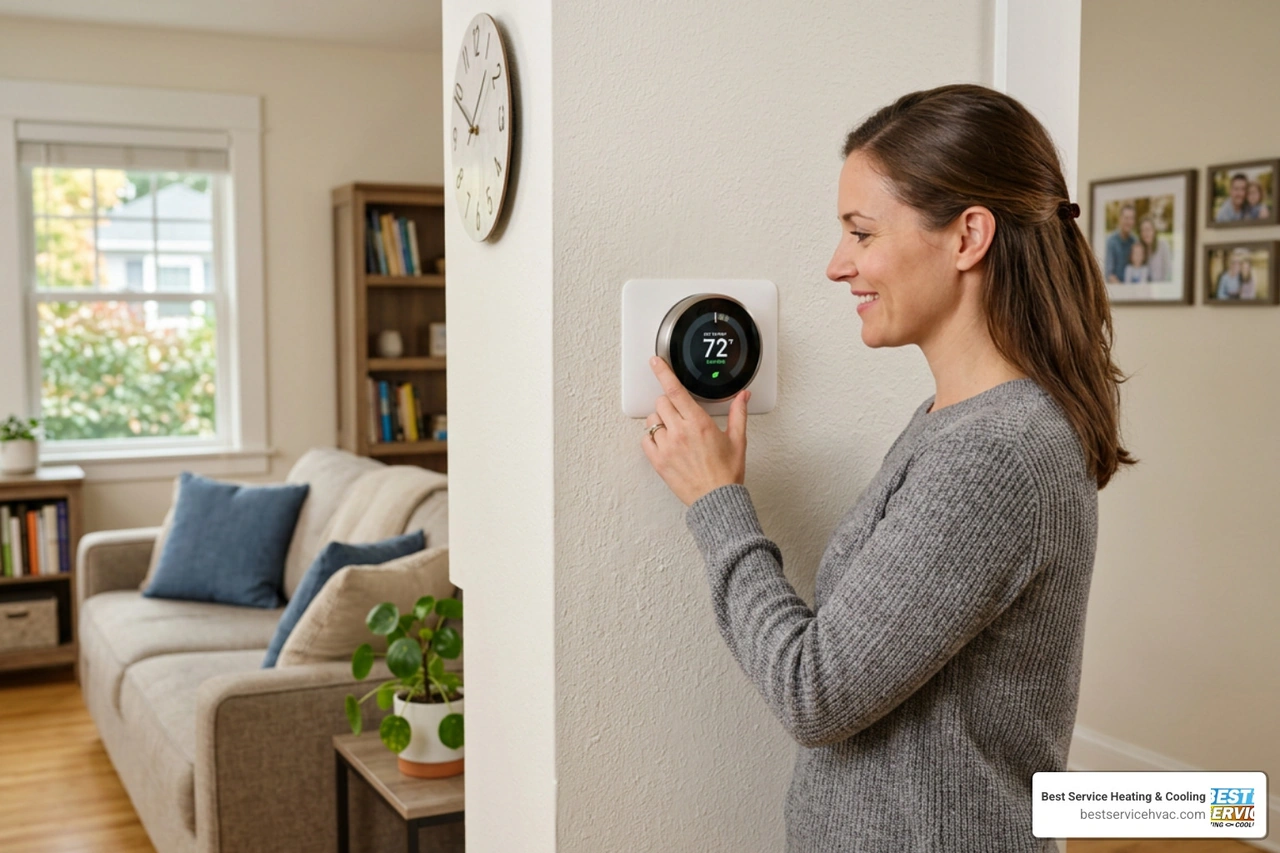
Efficiency isn't just about the machine in the basement; it's about the brain on the wall. Pairing a high-efficiency system with a programmable or smart thermostat can save an additional $180 per year on average.
Variable-speed blowers are another game-changer. Unlike standard motors that are either "all the way on" or "all the way off," variable-speed motors adjust their output to meet the exact needs of your home. This prevents the "blast of cold air" followed by a "hot spot" and keeps your energy usage at a steady, low hum. You can learn more about these mechanical advantages in our post on Energy Saving For Heating And Cooling System or check out our Ac Tune Up Guide Columbus Oh to see how tech and maintenance work together.
Maximizing Your Investment: Factors That Influence Real-World Savings
We often tell our neighbors in Grove City and Hilliard that a 20 SEER2 unit is only as good as the house it’s in. Several factors can either maximize or minimize your actual savings:
- Ductwork Integrity: If your ducts are leaky or undersized, you could be losing 20% to 30% of your conditioned air to the attic or crawlspace. No matter how efficient the unit is, it can't save money if the air never reaches your bedroom.
- Home Envelope: Insulation and window quality matter. If your attic insulation is thin, your high-efficiency furnace will have to work twice as hard to keep up.
- Manual J Calculations: "Bigger" is not always better. An oversized system will "short-cycle," turning on and off too quickly to dehumidify properly or reach peak efficiency. We use Manual J load calculations to ensure your system is perfectly sized for your square footage and layout.
- Maintenance: A high-efficiency system is a precision machine. Just like a high-performance car, it needs regular check-ups. You can read about Why Schedule Routine Home Hvac Service to see how keeping your coils clean and filters fresh protects your ROI.
Calculating the Payback Period for Your New System
The "payback period" is the time it takes for the energy savings to cover the extra upfront cost of a high-efficiency unit compared to a standard one.
For most Central Ohio homeowners, the payback period for a high-efficiency system typically runs between 5 and 12 years. Considering that a well-maintained furnace can last 20 to 30 years and an AC unit about 15 to 20 years, you’ll likely spend more than half the system’s life "in the green," where it is actively making you money.
To shorten that payback period, we recommend looking into:
- Utility Rebates: Companies like AEP Ohio and Columbia Gas often offer rebates ranging from $100 to over $1,000 for qualifying high-efficiency equipment.
- Federal Incentives: While the IRA 25C tax credits have shifted over time, various federal and state programs in 2026 still provide significant offsets for "green" home improvements.
- Maintenance Plans: Enrolling in a Maintenance Plan ensures your system stays at its peak efficiency rating for its entire lifespan, preventing the "efficiency creep" that happens when parts get dirty and worn.
Frequently Asked Questions about High-Efficiency Savings
Does a higher SEER2 rating always mean more savings?
While a higher SEER2 rating means the unit is capable of more savings, there is a point of diminishing returns. For example, jumping from 10 to 16 SEER2 offers a massive 37% savings. Going from 16 to 22 SEER2 offers an additional 27%. In a very mild climate, that extra jump might take too long to pay back. However, in our humid Ohio summers, that higher rating often pays for itself through superior moisture control and comfort.
When should I replace my system instead of repairing it?
We generally suggest the "10-year rule." If your system is over 10 years old and the repair cost is significant, it’s usually better to invest that money into a new, high-efficiency system. With energy bills rising, continuing to repair an old, inefficient unit is often "throwing good money after bad." Furthermore, older systems using phased-out refrigerants (like R-22) are becoming increasingly expensive to service.
Do high-efficiency systems improve indoor air quality?
Yes! Because high-efficiency systems (especially those with variable-speed motors) run longer cycles at lower speeds, they provide continuous air filtration. This means more air passes through your filters and IAQ products like UV lights or air purifiers. They also maintain much more consistent temperatures, eliminating the uncomfortable "hot and cold spots" often found in older homes in Bexley or Clintonville.
Conclusion
At the end of the day, the answer to "how much does a high efficiency system save" is measured in more than just dollars—it's measured in comfort, reliability, and peace of mind. By reducing your energy consumption by 30% to 50%, you aren't just lowering your bills; you're also reducing your household's carbon footprint by 1.5 to 3 tons of CO2 per year.
At Best Service Heating & Cooling, we’ve been helping our neighbors in Central Ohio navigate these choices since 1992. As a family-owned business with an A+ BBB rating, we pride ourselves on providing honest, data-driven advice. Whether you’re in Reynoldsburg, New Albany, or Upper Arlington, we’re here to help you do the math and find the system that fits your home and your budget perfectly.
Ready to start counting the coins you’ll save? Schedule your high-efficiency consultation in Columbus today and let us help you stay comfortable for less.
.webp)
.webp)

Service Areas
