
Is a Mini Split Better Than Central Air for Keeping Your Cool

Is a Mini Split Really Better Than Central Air? Here's What Columbus Homeowners Need to Know
The central ac vs ductless mini split comparison comes down to one core question: does your home already have ductwork, and how well is it actually working?
Here's a quick breakdown to help you decide at a glance:
| Factor | Central AC | Ductless Mini Split |
|---|---|---|
| Requires ductwork | Yes | No |
| Energy efficiency (SEER2) | 13–21+ | 18–38+ |
| Energy loss from ducts | Up to 25–30% | 0% |
| Zoning control | Limited | Room-by-room |
| Best for | Larger ducted homes | Additions, older homes, targeted comfort |
| Also provides heating | With heat pump or furnace | Yes, built-in heat pump |
| Noise level | Noticeable airflow | 19–26 decibels (whisper-quiet) |
| Typical lifespan | 15–20 years | 15–20 years |
If your home has well-sealed, properly insulated ductwork, central AC can be a cost-effective way to cool every room from a single system. But if your ducts are leaky, your home lacks them entirely, or you have rooms that never seem to reach the right temperature, a ductless mini split may be the smarter move.
Think of it this way: duct losses are a bit like buying a gallon of milk but having nearly a third of it leak out before you get home. According to the U.S. Department of Energy, duct systems can lose 25–30% of cooling energy through leaks and poor insulation. Mini splits skip that loss entirely by delivering conditioned air directly into the room.
For Central Ohio homeowners dealing with humid summers, older homes without existing ductwork, or stubborn "nuisance rooms" that never cool down right, this comparison matters more than ever in April 2026 — especially with updated DOE efficiency standards now in effect.
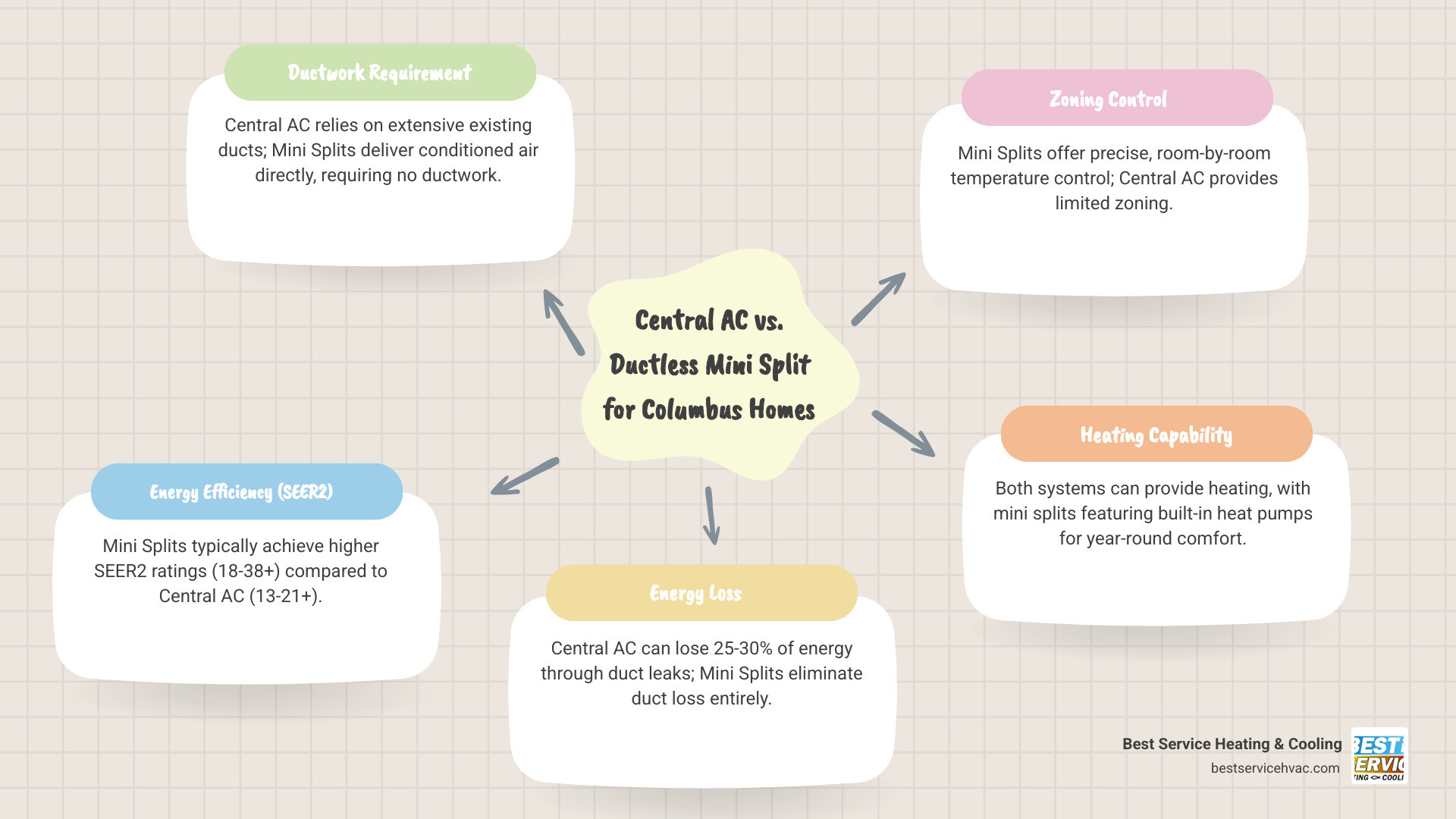
Understanding the Central AC vs Ductless Mini Split Comparison for Columbus Homes
When we talk about keeping a home in Columbus comfortable, we are usually looking at two very different philosophies of air distribution. Central air conditioning is the "all-in-one" solution most of us grew up with. It uses a single large indoor unit—often tucked away in a basement or utility closet—to push air through a network of metal or flexible ducts.
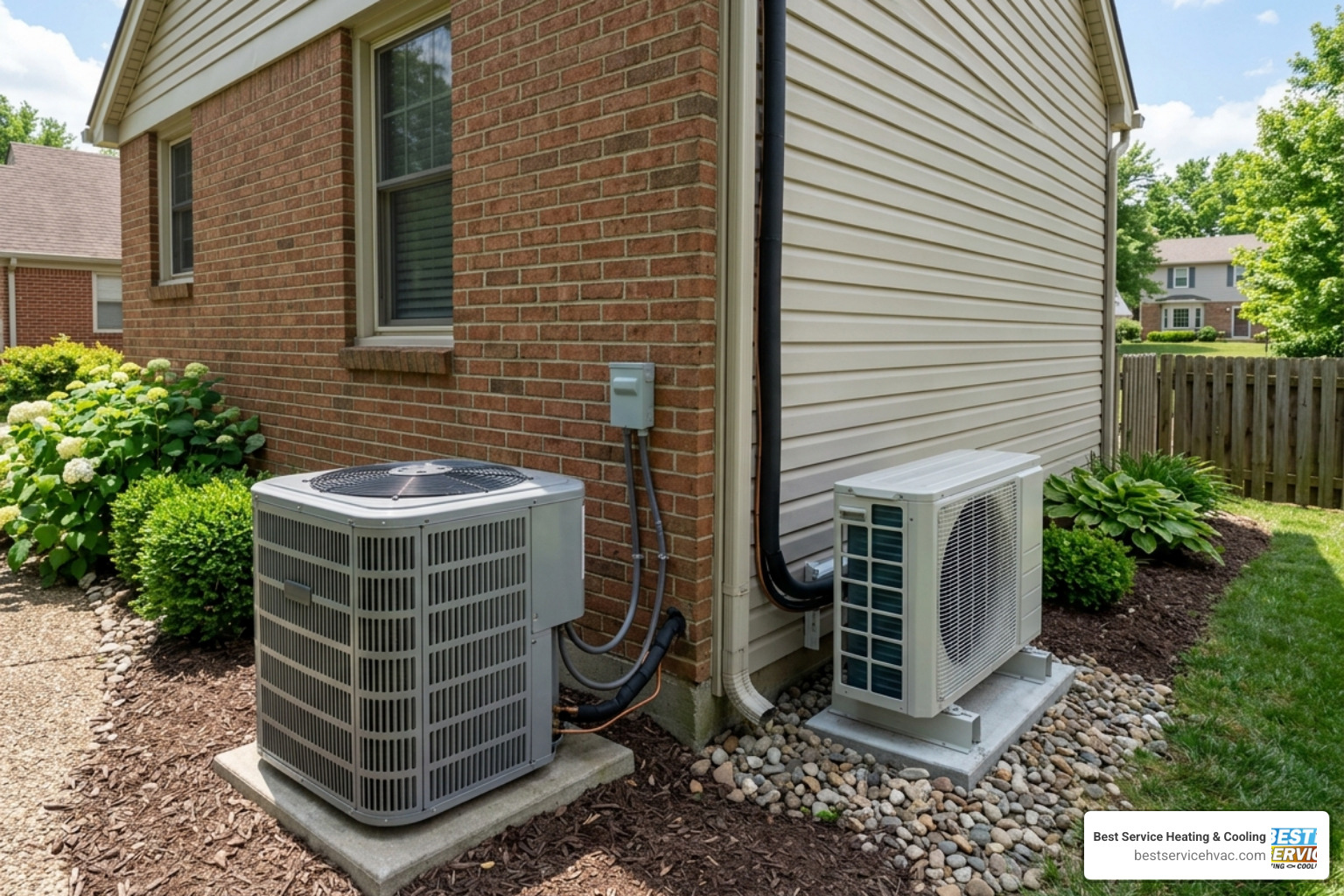
On the other side of the central ac vs ductless mini split comparison, we have the mini split. These systems are "decentralized." Instead of one big air handler, you have smaller indoor units (often called "heads") mounted directly on the walls or ceilings of the rooms you want to cool. Both systems rely on an outdoor condenser, but how they deliver that cool relief to your living room or bedroom is where the paths diverge.
For those exploring Air Conditioning Services, the choice often depends on the "bones" of the house. A classic home in Clintonville might have beautiful plaster walls but zero ductwork, making Mini-Split Services the obvious winner to avoid a messy renovation.
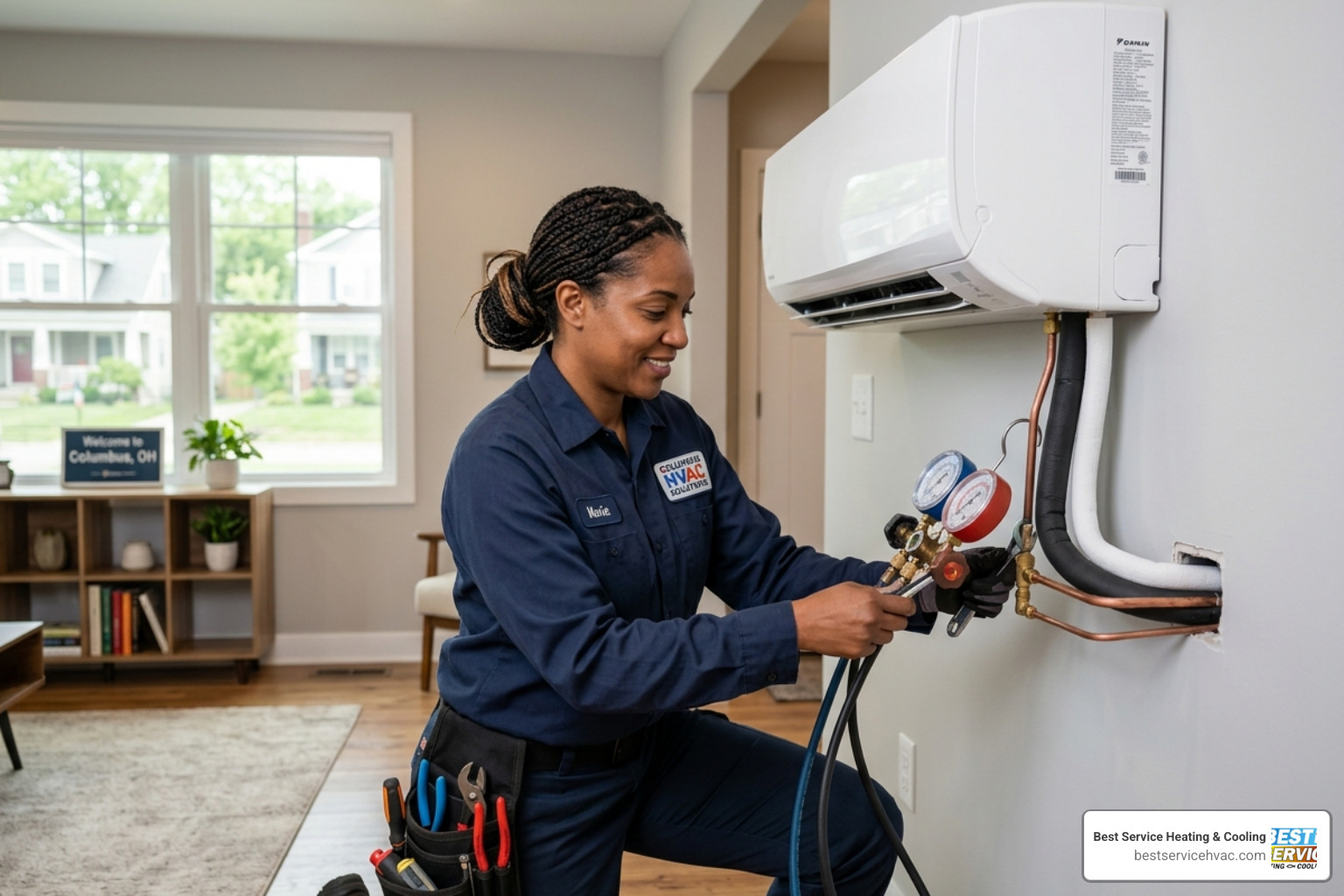
Key Differences in a Central AC vs Ductless Mini Split Comparison
The mechanical differences between these two are significant. Central AC relies on a large evaporator coil located inside your furnace or air handler. A powerful blower motor forces air across this coil and then through the ducts. This creates "forced air" cooling that aims for a uniform temperature across the whole house.
Ductless systems use thin refrigerant lines—usually only requiring a small three-inch hole in the exterior wall—to connect the outdoor unit to the indoor heads. Because there are no ducts, there is no need for a massive blower. This is a core part of HVAC Services today: finding the path of least resistance for maximum comfort.
Energy Efficiency: A Central AC vs Ductless Mini Split Comparison
In HVAC, efficiency is king. As of April 2026, the Department of Energy’s SEER2 (Seasonal Energy Efficiency Ratio 2) standards are the benchmark for how we measure cooling performance.
Central AC systems typically range from 13 to 21+ SEER2. While that’s respectable, ductless mini splits frequently achieve 18 to 38+ SEER2. Why the massive gap? It’s largely due to "duct loss." When air travels through ducts in a hot attic or a crawlspace, it picks up heat. If the ducts have even minor leaks, you’re paying to cool your attic instead of your bedroom. If you've noticed your system struggling, it might be time to learn how to identify and fix poor airflow from AC to see if your ducts are the culprit.
Efficiency and Performance: Which System Wins in Central Ohio?
When we look at the performance data for our region, the results are eye-opening. Central Ohio experiences high humidity, which makes efficiency even more critical.
| Performance Metric | Central AC | Ductless Mini Split |
|---|---|---|
| Max SEER2 Rating | ~26 SEER2 | ~35+ SEER2 |
| Air Delivery Efficiency | ~70-75% (due to duct loss) | 100% (direct delivery) |
| Compressor Tech | Single, Two-Stage, or Variable | Almost always Variable (Inverter) |
Mini splits use inverter technology, which acts like a dimmer switch for your cooling. Instead of slamming on at full blast and then shutting off (the "all or nothing" approach of many central units), the mini split scales its power up and down to maintain a perfect temperature. This prevents those annoying temperature swings and saves a significant amount of electricity.
Furthermore, under the Inflation Reduction Act, many high-efficiency heat pump systems—including many mini splits—qualify for federal tax credits of up to $2,000. For homeowners considering Air Conditioning Replacement Columbus OH, these incentives can make the jump to high-efficiency technology much more accessible.
Installation and Home Suitability Factors
The "best" system is often the one that fits your home's layout without requiring you to tear down walls.
For a new build in New Albany, installing ductwork is part of the plan, making central air a seamless choice. Our team performing Air Conditioning Installation New Albany OH often sees central systems as the standard for modern, open-concept floor plans.
However, for a Mini-Split Installation Columbus OH in an older German Village home, the "ductless" part is a lifesaver. You don't have to sacrifice closet space or drop ceilings to hide bulky metal pipes.
Addressing Homes Without Existing Ductwork
If your home currently uses baseboard heat or radiators, it likely lacks the ductwork needed for central air. Adding ducts to an existing home can be an invasive and expensive process, sometimes adding up to $18,000 to the total project cost.
Ductless systems avoid this entirely. We use "line hides" (decorative covers for the refrigerant lines) to keep the exterior of your home looking sharp while protecting the components from the Ohio elements. This makes HVAC Replacement Pataskala OH much simpler for homes built on slabs or with limited crawlspace.
Choosing the Right System for Large Columbus Properties
For very large homes—say, over 2,500 square feet—central AC often provides the most consistent whole-home uniformity. It’s designed to move a high volume of air (measured in Cubic Feet per Minute, or CFM) to ensure that even the middle of the house stays cool.
Central systems also allow for more robust air filtration. You can add high-end HEPA filters or UV light purifiers directly into the ductwork to clean the air for the entire house at once. If your current central system is struggling to keep up with a large floor plan, our AC Repair Columbus OH Guide 2025 offers some great troubleshooting tips.
Comfort Features: Zoning, Noise, and Air Quality
One of the most common complaints we hear from Columbus homeowners is the "upstairs-downstairs" battle. You know the one: the living room is a refrigerator, but the master bedroom is a sauna.
Advantages of Individual Room Zoning
Ductless mini splits are the undisputed champions of zoning. Each indoor head has its own thermostat. If you like your bedroom at 68 degrees but want the guest room at 74, you can do that. This "occupancy-based cooling" means you aren't paying to cool the kitchen at 3:00 AM.
For those looking at Mini-Split Replacement Westerville OH, the ability to turn off zones in unused parts of the house can lead to energy savings of up to 30% compared to a central system.
Aesthetics and Indoor Air Quality Integration
While some people aren't fans of seeing a unit on the wall, modern mini splits are sleek and low-profile. There are even "ceiling cassettes" that sit flush with the ceiling, becoming almost invisible. We've written extensively about the space-saving benefits mini-split AC installation offers for smaller Columbus apartments and offices.
In terms of noise, mini splits are whisper-quiet, often operating at 19–26 decibels. That’s quieter than a library! Central AC is generally louder due to the sound of air rushing through vents. However, if your mini split starts making strange noises, you may need a Mini-Split Repair Worthington OH to check the condensate pump or fan motor.
Frequently Asked Questions about Cooling Systems
Can these systems provide effective heating during Ohio winters?
Yes! Most modern mini splits are actually "heat pumps." They can reverse their operation to pull heat from the outdoor air and move it inside. Many "cold-climate" models are now efficient even when temperatures drop well below zero. Central systems can also be heat pumps, though many in Ohio are paired with a gas furnace for a "dual-fuel" setup.
Is a hybrid system using both central AC and mini-splits a viable option?
Absolutely. This is often the "best of both worlds" solution. We frequently install central AC for the main body of the house and then add a single-zone mini split for a finished basement, a garage workshop, or a new sunroom addition that wasn't connected to the original ducts.
What are the typical lifespan and maintenance requirements for each?
Both systems generally last 15–20 years if they are well-maintained.
- Central AC: Requires changing the large furnace filter every 30–90 days and an annual professional tune-up.
- Mini Split: The small filters inside the indoor heads should be rinsed and dried every 2–4 weeks. Professional maintenance is needed to check refrigerant levels and clean the outdoor coils. For residents in Mini-Split Replacement Westerville OH, keeping these filters clean is the #1 way to ensure your system reaches that 20-year mark.
Conclusion
The central ac vs ductless mini split comparison doesn't have a single "winner"—it only has the right choice for your specific home and comfort goals. If you have a large home with existing, high-quality ductwork, a modern central AC system is a fantastic, reliable investment. But if you’re looking for precision control, living in a historic home, or adding on a new room, the efficiency and flexibility of a ductless mini split are hard to beat.
At Best Service Heating & Cooling, we’ve been helping our neighbors in Columbus, Dublin, Westerville, and throughout Central Ohio find their perfect comfort zone since 1992. As a family-owned business with an A+ BBB rating, we take pride in providing honest, expert advice tailored to the local climate.
Ready to find out which system will keep you coolest this summer? Schedule your consultation for a mini-split system today and let us help you build a custom comfort solution for your home.
.webp)
.webp)

Service Areas
