
How to Calculate Proper HVAC Sizing for Central Ohio Homes

Why Getting the Right Size HVAC for Central Ohio Homes Is the First Step to Real Comfort
Getting the right size HVAC for Central Ohio homes starts with one key fact: square footage alone does not determine the correct system size. Here is a quick-reference guide to help you understand what sizing actually involves:
Quick Answer: How to Get the Right HVAC Size for Your Central Ohio Home
| Step | What It Involves |
|---|---|
| 1. Request a Manual J calculation | A room-by-room load analysis based on your actual home |
| 2. Account for insulation and windows | Older homes and single-pane glass need more capacity |
| 3. Factor in local climate | Central Ohio's humid summers and cold winters affect both heating and cooling loads |
| 4. Match equipment to the load | Use the calculation results to select the right tonnage and output |
| 5. Verify ductwork compatibility | Duct size and condition must support the new system |
Up to half of all residential HVAC systems in the United States are improperly sized. In Central Ohio, where summers bring heavy humidity and winters regularly push temperatures below freezing, an incorrectly sized system does not just waste energy — it fails to keep your home comfortable at all.
A system that is too large short-cycles, meaning it turns on and off too quickly to remove moisture from the air. A system that is too small runs constantly and never quite catches up on the coldest or hottest days. Either way, you end up paying more and getting less.
The good news is that getting this right is not complicated when you work with a qualified HVAC professional who follows the correct process. This guide walks you through everything Central Ohio homeowners need to know.

What HVAC Sizing Actually Means
HVAC sizing is the process of matching your heating and cooling equipment to your home’s real comfort needs. It does not mean the physical size of the furnace, air conditioner, or heat pump. It means capacity.
Here are the basic terms homeowners should know:
- BTU: British Thermal Unit. This measures heating or cooling energy.
- Ton: A cooling measurement. One ton equals 12,000 BTUs per hour.
- Cooling load: How much heat your AC or heat pump must remove.
- Heating load: How much heat your furnace or heat pump must add.
- Furnace output: The usable heat your furnace delivers after efficiency is considered.
- Heat pump capacity: How much heating and cooling the heat pump can provide under specific outdoor conditions.
As a rough starting point, one ton of air conditioning capacity can cool about 500 to 600 square feet of living space in many residential homes. So, a 3-ton system might be associated with roughly 1,500 to 1,800 square feet. But that shortcut can be wrong by a lot, especially in older homes, two-story homes, shaded homes, homes with finished basements, or homes with big west-facing windows.
For a deeper look at whole-home comfort systems, visit our HVAC services page.
Why Central Ohio Homes Need Local Sizing Instead of a Generic Rule
Central Ohio homes are not all built the same, and they do not all experience heating and cooling loads the same way.
A brick home in German Village may behave differently from a newer home in New Albany. A shaded house in Clintonville may need less cooling than an open-lot home in Grove City. A two-story home in Dublin may have upstairs cooling challenges that a ranch in Reynoldsburg does not. A finished basement in Pickerington, an addition in Westerville, or older ductwork in Gahanna can all change the calculation.
Central Ohio sizing has to account for:
- Humid summer afternoons
- Cold winter nights
- Quick spring and fall temperature swings
- Tree cover and sun exposure
- Home age and construction style
- Attic and wall insulation
- Duct condition and airflow
- Room layout and ceiling height
Generic rules are fine for napkin math. They are not enough for selecting equipment that needs to keep your family comfortable for years.
How Professionals Calculate Proper HVAC Size in Central Ohio
Professional HVAC sizing starts with a load calculation. The gold standard for homes is a Manual J calculation, followed by proper equipment selection and duct evaluation.
In plain English:
- Manual J calculates the heating and cooling load.
- Manual S helps match equipment to that load.
- Manual D helps evaluate ductwork and airflow needs.
Together, these steps help us avoid the classic “bigger must be better” mistake. Spoiler alert: bigger is not always better. In HVAC, oversized equipment is like using a fire hose to water a houseplant. It technically works, but it creates a mess.
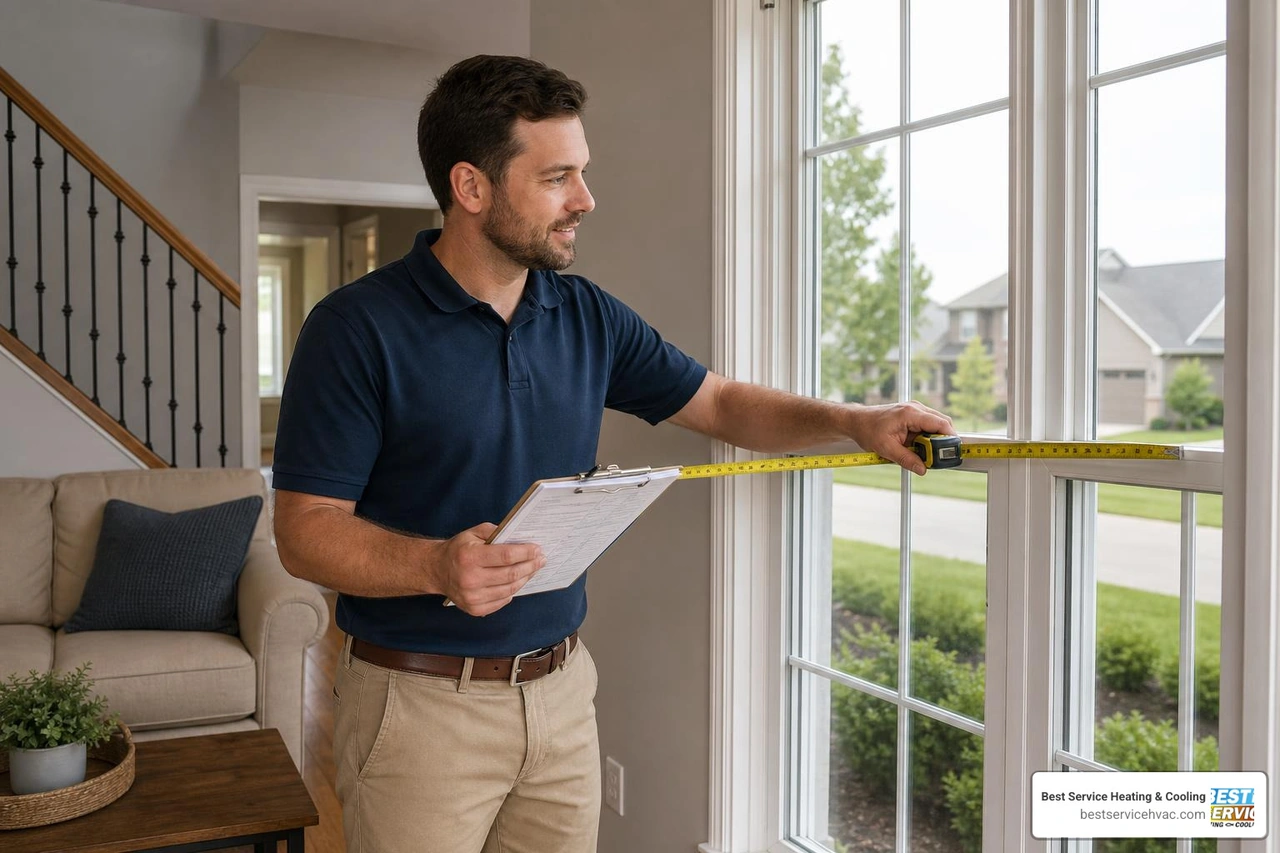
What a Manual J Load Calculation Measures
A Manual J load calculation is a detailed, room-by-room analysis of your home. It looks at how heat enters, leaves, and moves through the structure.
A proper Manual J may include:
- Total square footage
- Room-by-room dimensions
- Ceiling height
- Window size, type, and direction
- Door quality and leakage
- Wall area and insulation value
- Attic insulation
- Basement or crawl space conditions
- Air leakage and drafts
- Home orientation
- Shade from trees, awnings, or nearby structures
- Number of occupants
- Heat from appliances and lighting
- Duct location and duct losses
- Local Central Ohio climate data
This is why two homes with the same square footage can need different HVAC sizes. One may have newer windows, strong attic insulation, and good ductwork. The other may have drafty rooms, leaky ducts, and a large west-facing glass wall that turns the living room into a toaster oven every July.
Why Homeowners Should Insist on Manual J Before Installation
Before replacing an HVAC system, homeowners should ask for a Manual J calculation because it documents what the home actually needs. Guessing based on the old system is risky because the old system may have been wrong from day one.
Manual J helps with:
- More accurate heating and cooling capacity
- Better humidity control
- Fewer hot and cold rooms
- Reduced short cycling
- Better equipment protection
- Improved airflow planning
- Better comfort in extreme weather
- More confidence before installation
It is also important if your home has changed since the current system was installed. New windows, added insulation, remodeled rooms, finished basements, or home additions can all change the load.
If you are planning a replacement, our guide to the best AC installation for your home explains why installation quality and sizing go hand in hand.
Quick Sizing Estimates vs Professional Calculations
Square-footage rules can help homeowners understand ballpark capacity, but they should not be used as the final answer.
| Method | What It Uses | Best For | Main Limitation |
|---|---|---|---|
| Square-footage estimate | Home size only | Rough planning | Ignores insulation, windows, layout, climate, and ducts |
| BTU-per-square-foot rule | Size plus climate assumptions | Early conversations | Often assumes standard ceilings and average construction |
| Manual J calculation | Room-by-room home data | Final equipment sizing | Requires professional measurements and inputs |
| Manual S equipment match | Manual J results plus equipment performance | Choosing the right model | Must be paired with accurate load data |
| Duct/airflow evaluation | Duct size, leakage, static pressure, returns | Confirming comfort delivery | Cannot fix wrong equipment sizing by itself |
A rough AC estimate may use 500 to 600 square feet per ton. Furnace sizing may use BTU ranges based on home size and climate. But standard shortcuts often assume 8-foot ceilings, average insulation, and typical windows. That may not fit a vaulted great room in Powell, an older home in Franklinton, or a remodeled property in Grandview.
The same sizing principle applies across home comfort equipment. If you have ever wondered why capacity matters for other systems too, our guide on what size water heater you need is a helpful comparison.
Home Factors Beyond Square Footage That Affect HVAC Sizing
Square footage matters, but it is only one ingredient. Think of HVAC sizing like baking: flour matters, but if you ignore the oven temperature, eggs, timing, and whether someone replaced sugar with salt, the cake is not going to win any awards.
Climate, Insulation, and Air Sealing
Central Ohio has humid summers and cold winter stretches, so sizing must account for both cooling and heating performance.
Insulation and air sealing can dramatically change the load. A well-insulated home holds conditioned air longer. A drafty home loses heat in winter and gains heat in summer.
Important areas include:
- Attic insulation
- Wall insulation
- Rim joists
- Basement or crawl space sealing
- Weatherstripping
- Door sweeps
- Recessed lighting leaks
- Duct leakage in unconditioned spaces
Older homes in areas like Bexley, German Village, Clintonville, Worthington, and parts of Columbus may need special attention before new AC installation. For more on that, see our guide to preparing your older home for AC installation.
A blower door test can also help measure air leakage when a home has persistent drafts or comfort issues.
Windows, Sun Exposure, and Home Orientation
Windows can add a surprising amount of heating and cooling load.
A room with single-pane windows usually gains and loses more heat than a room with modern double-pane low-E windows. Direction matters too:
- West-facing windows often create late-day heat gain.
- South-facing rooms may gain helpful winter sun but extra summer heat.
- North-facing rooms may stay cooler and need more winter heating.
- Shaded rooms may have lower cooling needs.
- Open lots may experience more sun and wind exposure.
Mature trees, awnings, porch roofs, and neighboring structures can reduce cooling load. In some homes, shade can make a room feel completely different from the same room layout on a sunnier lot.
Layout, Ceiling Height, Ductwork, and Airflow
Home layout has a major impact on comfort.
A ranch home, a two-story home, and a home with vaulted ceilings can all need different equipment and airflow strategies even if the square footage is similar.
Sizing should consider:
- Open floor plans
- Two-story temperature differences
- Vaulted or 10-foot ceilings
- Long duct runs
- Supply vent placement
- Return air pathways
- Duct leakage
- Static pressure
- Room additions
- Finished basements
- Bonus rooms over garages
Ductwork is especially important. A correctly sized system cannot perform well if the ducts cannot move the required air. Weak return air, undersized ducts, or leaks can make a new system feel disappointing even when the equipment is technically correct.
For cooling-specific comfort information, visit our air conditioning services page.
Heat Pumps, Furnaces, Central AC, and Mini-Splits
Different HVAC systems are sized differently, but the goal is the same: match capacity to the home.
Common Central Ohio options include:
- Central air conditioning with a gas furnace
- Heat pumps
- Dual-fuel or hybrid systems
- Ductless mini-splits
- Zoned comfort systems
A ductless mini-split can be a smart solution for a room addition, finished garage, bonus room, sunroom, or area that never feels comfortable with the main system. For help comparing options, read our central AC vs ductless mini split comparison and our guide to choosing the right mini split system for your property.
For light commercial spaces, sizing becomes even more specialized because occupancy, equipment, kitchens, and ventilation needs can affect the load. Our article on custom AC for light commercial spaces explains that process in more detail.
Problems Caused by the Wrong HVAC Size
Incorrect HVAC size usually shows up as comfort problems first. Then it shows up as higher utility use, more wear, more repairs, and shorter equipment life.
What Happens When the System Is Too Large
An oversized AC or heat pump cools the home too quickly and shuts off before it has run long enough to remove moisture. That creates the classic Central Ohio summer complaint: “The thermostat says it is cool, but the house still feels sticky.”
Oversized systems can cause:
- Short cycling
- Poor dehumidification
- Cold but clammy rooms
- Uneven temperatures
- Noisy starts and stops
- Extra wear on compressors, motors, and controls
- Reduced equipment lifespan
- Higher energy waste
- Mold or dampness concerns in humid areas
A properly sized AC should run in longer, steadier cycles. That runtime is what allows moisture to condense on the indoor coil and drain away.
What Happens When the System Is Too Small
An undersized system has the opposite problem: it runs and runs but cannot keep up.
Signs of an undersized system include:
- Long runtimes with little temperature change
- Hot upstairs rooms in summer
- Cold rooms in winter
- Thermostat settings that are never reached
- Slow recovery after setback periods
- Weak comfort during extreme weather
- Stressed components
- Higher wear from constant operation
During cold Central Ohio weather, an undersized furnace or heat pump may struggle to maintain comfort. If heating is your main concern, our heating services page explains available repair, replacement, and maintenance options.
Signs You Need Help Getting the Right Size HVAC for Central Ohio Homes
If you are wondering whether your current system is the wrong size, track these warning signs before calling us:
- The system turns on and off every few minutes.
- The system runs constantly but never catches up.
- Indoor humidity regularly rises above 60 percent.
- Some rooms are much hotter or colder than others.
- Upstairs rooms are uncomfortable in summer.
- The thermostat room feels fine, but other rooms do not.
- Energy use keeps rising without a clear reason.
- The system is louder than expected during startup.
- You need frequent repairs.
- The air feels dusty, stale, or uneven.
- The home feels cold and clammy after the AC runs.
- Comfort changed after remodeling, insulation work, or new windows.
These symptoms do not always mean the equipment size is wrong. Ductwork, refrigerant charge, maintenance, thermostat placement, and airflow can also cause problems. But they are good reasons to have the whole system evaluated.
How Proper Sizing Improves Comfort, Humidity Control, and Equipment Life
A right-sized HVAC system does not just heat and cool. It does it steadily.
Proper sizing supports:
- Longer, more stable cycles
- More even room temperatures
- Better summer moisture removal
- Indoor humidity between about 40 and 60 percent
- Less energy waste
- Quieter operation
- Fewer comfort complaints
- Less strain on major parts
- Better long-term performance
- Stronger home value perception during resale
A properly sized system feels less dramatic. It does not blast, stop, blast, stop, and make everyone argue over the thermostat like it is a family board game.
Why Right-Sized Systems Control Ohio Summer Humidity Better
Air conditioning removes both sensible heat and latent heat. Sensible heat is the temperature you see on the thermostat. Latent heat is moisture in the air.
To remove moisture, the AC coil needs enough runtime. When warm indoor air passes over the cold coil, moisture condenses and drains away. If the system is oversized, it shuts off before enough moisture is removed.
That is why oversized systems often make homes feel:
- Cool but damp
- Sticky in bedrooms
- Musty in basements or lower levels
- Uncomfortable even at a lower thermostat setting
Variable-speed and multi-stage systems can help because they run longer at lower capacity, which supports better dehumidification. But even high-end equipment must still be sized and installed correctly.
How Sizing Affects Efficiency Ratings and System Performance
Efficiency ratings matter, but they do not rescue poor sizing.
Common HVAC efficiency ratings include:
- SEER2: Cooling efficiency for air conditioners and heat pumps
- AFUE: Heating efficiency for furnaces
- HSPF2: Heating efficiency for heat pumps
A high-efficiency system that is oversized, poorly matched to ductwork, or installed without proper airflow can still perform poorly. Capacity, duct compatibility, thermostat setup, refrigerant charge, and installation quality all matter.
If you are comparing equipment options, our standard vs high efficiency HVAC comparison can help you understand how efficiency ratings fit into the bigger comfort picture.
When to Recalculate HVAC Sizing
You should recalculate HVAC sizing whenever the home or comfort needs change.
Ask for a new load calculation when:
- Replacing a furnace, AC, or heat pump
- Adding living space
- Finishing a basement
- Converting an attic or garage area
- Replacing windows
- Adding insulation
- Sealing major air leaks
- Changing ductwork
- Remodeling the layout
- Adding zoning
- Noticing hot or cold rooms
- Experiencing humidity problems
- Occupancy changes significantly
A properly sized new system can also support resale value by improving comfort, efficiency, and buyer confidence. Learn more in our guide on how a new HVAC system increases home value.
Frequently Asked Questions About HVAC Sizing for Central Ohio Homes
What Size HVAC System Does a 2,000-Square-Foot Central Ohio Home Need?
A rough estimate for a 2,000-square-foot Central Ohio home might fall around 3 to 4 tons of cooling capacity, but that is only a starting point.
The real answer depends on:
- Insulation levels
- Window type and orientation
- Ceiling height
- Home layout
- Ductwork condition
- Air leakage
- Shade and sun exposure
- Basement conditions
- Number of occupants
- Heating requirements
A tight, well-insulated home with good windows may need less capacity than expected. A drafty home with high ceilings and large west-facing windows may need more. Manual J is the only reliable way to choose the final size.
Is a Bigger HVAC System Better for Hot Columbus Summers?
No. Bigger is not automatically better.
An oversized AC may lower the temperature quickly, but it will likely shut off before removing enough moisture. In a humid Central Ohio summer, that can leave your home feeling clammy even when the thermostat says it is cool.
A right-sized system runs longer, steadier cycles. That means better dehumidification, fewer temperature swings, and less wear from constant starting and stopping.
Questions to Ask About Getting the Right Size HVAC for Central Ohio Homes
Before approving a new system installation, ask clear questions like these:
- Will you perform a Manual J load calculation?
- Will the calculation be room by room or whole-house only?
- What measurements will you take inside the home?
- How will insulation levels be included?
- How will window size, type, and direction be included?
- Will you evaluate ductwork size and condition?
- Will you check return air and supply balance?
- Will airflow be tested or verified?
- How will you match the equipment to the load calculation?
- Is the system single-stage, two-stage, or variable-speed?
- How will humidity control be addressed?
- Are permits required for this installation?
- What warranty coverage applies to equipment and workmanship?
- What maintenance plan do you recommend after installation?
- How will the system be commissioned and tested after startup?
The goal is not to make homeowners become HVAC engineers. The goal is to make sure your comfort system is selected using real data, not guesswork.
Conclusion
Getting HVAC sizing right is one of the most important steps in creating dependable comfort for Central Ohio homes. Square footage gives you a rough starting point, but the final answer must include climate, insulation, windows, layout, ductwork, humidity control, and equipment matching.
At Best Service Heating & Cooling, we have served Central Ohio homeowners since 1992. As a family-owned HVAC company with an A+ BBB rating, we help homeowners in Columbus, Reynoldsburg, Dublin, Westerville, Gahanna, Grove City, New Albany, Pickerington, and nearby communities choose, repair, replace, and maintain comfort systems that fit their homes.
Whether you are replacing an aging furnace, upgrading your AC, considering a heat pump, solving uneven temperatures, or trying to control summer humidity, proper sizing is the place to start.
For help with getting the right size HVAC for Central Ohio homes, visit our HVAC services page or learn more about our Columbus service area.

.webp)
.webp)

Service Areas
