
The Ins and Outs of How Your HVAC Affects Indoor Air Quality

Why Understanding How Your HVAC Affects Indoor Air Quality Matters for Columbus Homeowners
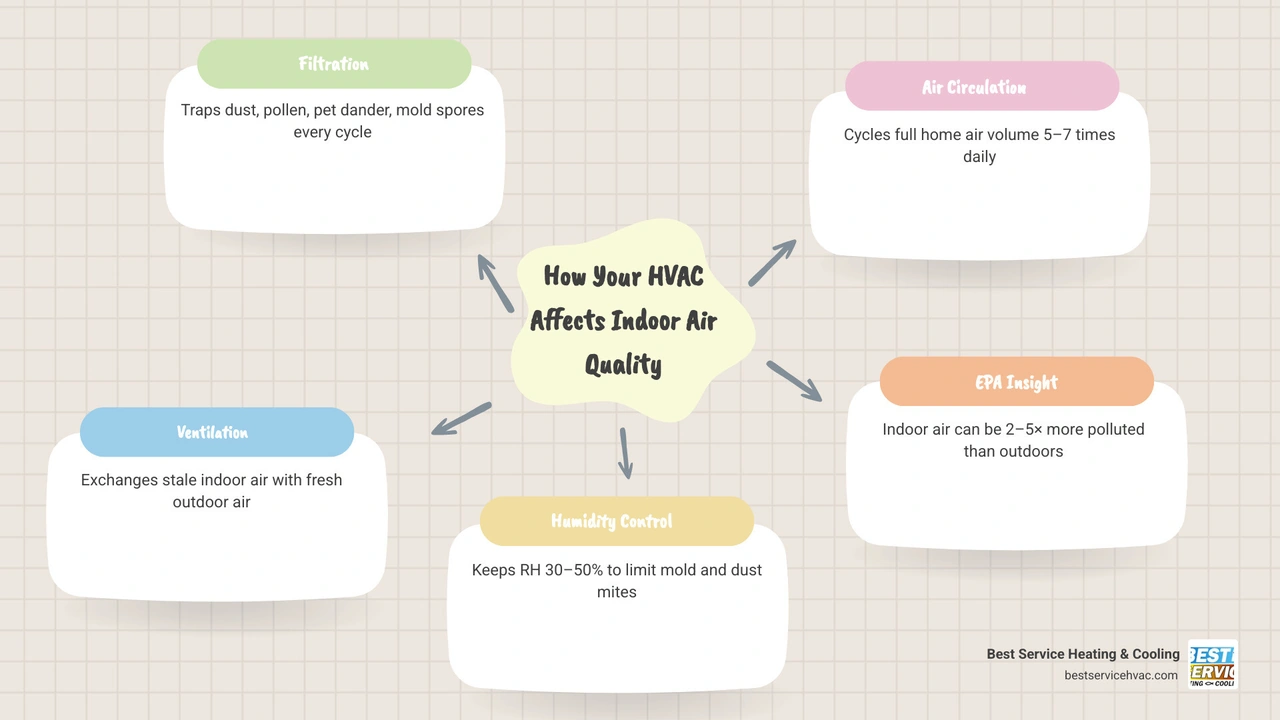
How your HVAC affects indoor air quality is simpler to understand than most people think — your system is constantly moving, filtering, and conditioning the air your family breathes every single day. Here is a quick breakdown:
- Filtration: Your HVAC filter traps dust, pollen, pet dander, mold spores, and other airborne particles every time air passes through the system
- Ventilation: The system exchanges stale indoor air with fresh outdoor air, diluting built-up carbon dioxide and volatile organic compounds (VOCs)
- Humidity control: By adding or removing moisture, your HVAC keeps relative humidity in the 30–50% range where mold and dust mites struggle to survive
- Air circulation: A properly running system cycles your home's entire air volume multiple times per day, preventing pollutants from settling and concentrating
Most Central Ohio homeowners are surprised to learn that the EPA estimates indoor air can be 2 to 5 times more polluted than outdoor air — and in some cases up to 100 times worse. We spend roughly 90% of our time indoors, which means the equipment quietly humming in your basement or utility closet has a direct, daily impact on your health and comfort.
Modern homes in Columbus and the surrounding communities are built tighter than ever. That energy efficiency is great for your utility bills, but it also means your home traps whatever is already inside — cooking fumes, cleaning product chemicals, pet allergens, and humidity — with nowhere to go unless your HVAC system is doing its job well. When it is not, you may notice more allergy symptoms, musty odors, stuffy rooms, or even persistent headaches that seem to improve once you step outside. That last detail is actually the hallmark of what experts call sick building syndrome.
The good news is that your existing HVAC system — paired with the right components and regular maintenance — is your most powerful tool for cleaner indoor air.
The Core Mechanics of How Your HVAC Affects Indoor Air Quality
To understand how your HVAC affects indoor air quality, think of your heating and cooling system as the "breathing apparatus" of your home. It pulls air from your living spaces through return registers, filters it, heats or cools it, and then pushes it back through supply vents. In a properly sized home system, this cycle repeats 5 to 7 times a day, processing your entire indoor air volume every 15 to 30 minutes.
If your system is clean and running efficiently, this continuous cycle is a massive benefit. It ensures that particulate matter (like dust, pet dander, and soot) and biological contaminants (like mold spores, bacteria, and virus-carrying droplets) are consistently pulled out of the breathing zone.
However, if your HVAC system is poorly maintained, has leaky ductwork, or runs with a clogged filter, it can actually spread pollutants. Unsealed ductwork in a dusty attic or damp crawl space can pull in dirty air and blow it directly into your bedrooms. When contaminants build up inside the system, they can trigger "sick home syndrome," causing family members to experience headaches, dry coughs, eye irritation, and fatigue. Learning How to Improve Indoor Air Quality at Home starts with understanding the mechanical role your heating and cooling system plays in moving this air.
Understanding how your hvac affects indoor air quality through filtration
Air filtration is your first line of defense against airborne irritants. Your air filter’s ability to trap particles is measured by its Minimum Efficiency Reporting Value (MERV) rating, which ranges from 1 to 16 for residential and light commercial systems.
Historically, standard one-inch fiberglass filters have been used in homes since the 1950s. However, these basic filters are only designed to protect the HVAC equipment itself from large dust bunnies—they do almost nothing to clean the air you breathe. Upgrading to a deeper, four-inch media cabinet allows you to use higher-efficiency filters without restricting your system's airflow.
| Filter Type & MERV Rating | Particle Size Captured | Common Pollutants Targeted | Best Suited For |
|---|---|---|---|
| MERV 1–4 (Fiberglass) | > 10.0 microns | Large dust, carpet fibers, lint | Basic equipment protection only |
| MERV 5–8 (Basic Pleated) | 3.0 to 10.0 microns | Pollen, dust mites, mold spores | Standard homes with no pets or allergies |
| MERV 11–12 (Deep Pleated) | 1.0 to 3.0 microns | Fine dust, pet dander, auto emissions | Homes with pets, mild allergies, or asthma |
| MERV 13–16 (High-Efficiency) | 0.3 to 1.0 microns | Bacteria, smoke, virus droplets | Maximum protection; ideal for respiratory sensitivities |
While high-efficiency filters like MERV 13 are highly recommended for capturing microscopic pathogens, they also create more resistance to airflow (known as static pressure). If your HVAC system is not designed to handle this resistance, it can cause your blower motor to overwork, leading to higher energy bills and premature system failure.
To achieve optimal filtration without putting stress on your furnace or heat pump, we often recommend installing dedicated Whole House Air Filtration Columbus OH systems. These media cabinets provide a much larger surface area, allowing high-efficiency particle capture with very low pressure drop. If you are unsure which filter rating is safe for your specific setup, our team can perform static pressure tests through our professional Filtration Services Columbus OH.
Managing humidity and how your hvac affects indoor air quality
Temperature is only half of the indoor comfort equation; humidity is the other. Your HVAC system plays a critical role in managing moisture levels, which directly impacts biological contaminant growth. The EPA recommends keeping indoor relative humidity (RH) strictly between 30% and 50% (though up to 60% is acceptable in some climates).
When humidity rises above 60%, your home becomes a breeding ground for mold, mildew, and dust mites. Conversely, when relative humidity drops below 30%—a common issue during cold Central Ohio winters when heating systems run constantly—it can dry out your nasal passages, making you more susceptible to respiratory infections, while also causing wood floors to warp and shrink.
Your air conditioner naturally removes moisture from the air during the summer cooling cycle. However, if your AC unit is oversized, it will "short cycle" (turn on and off too quickly), cooling the house down before it has run long enough to pull out excess humidity.
For year-round humidity control, installing Whole House Dehumidifiers Columbus OH can assist your AC on muggy summer days. For the dry winter months, integrating Whole House Humidification Columbus OH, such as high-efficiency Evaporative Humidifiers Columbus OH, directly into your ductwork ensures consistent, healthy moisture levels across every room in your home.
Ventilation Strategies: Bringing Fresh Air Indoors
Because modern homes in areas like Dublin, Westerville, and Gahanna are tightly sealed for energy efficiency, they tend to trap carbon dioxide ($CO2$) and volatile organic compounds (VOCs) released by household cleaning products, paints, and new furniture. Without proper ventilation, $CO2$ levels can easily exceed 1,500 ppm in closed bedrooms overnight, leading to morning headaches and sluggishness.
The national standard for residential ventilation is ASHRAE 62.2, which prescribes a continuous supply of fresh air based on your home's square footage and bedroom count. For a typical 2,000-square-foot, three-bedroom home, this requires about 60 cubic feet per minute (CFM) of fresh outdoor air.
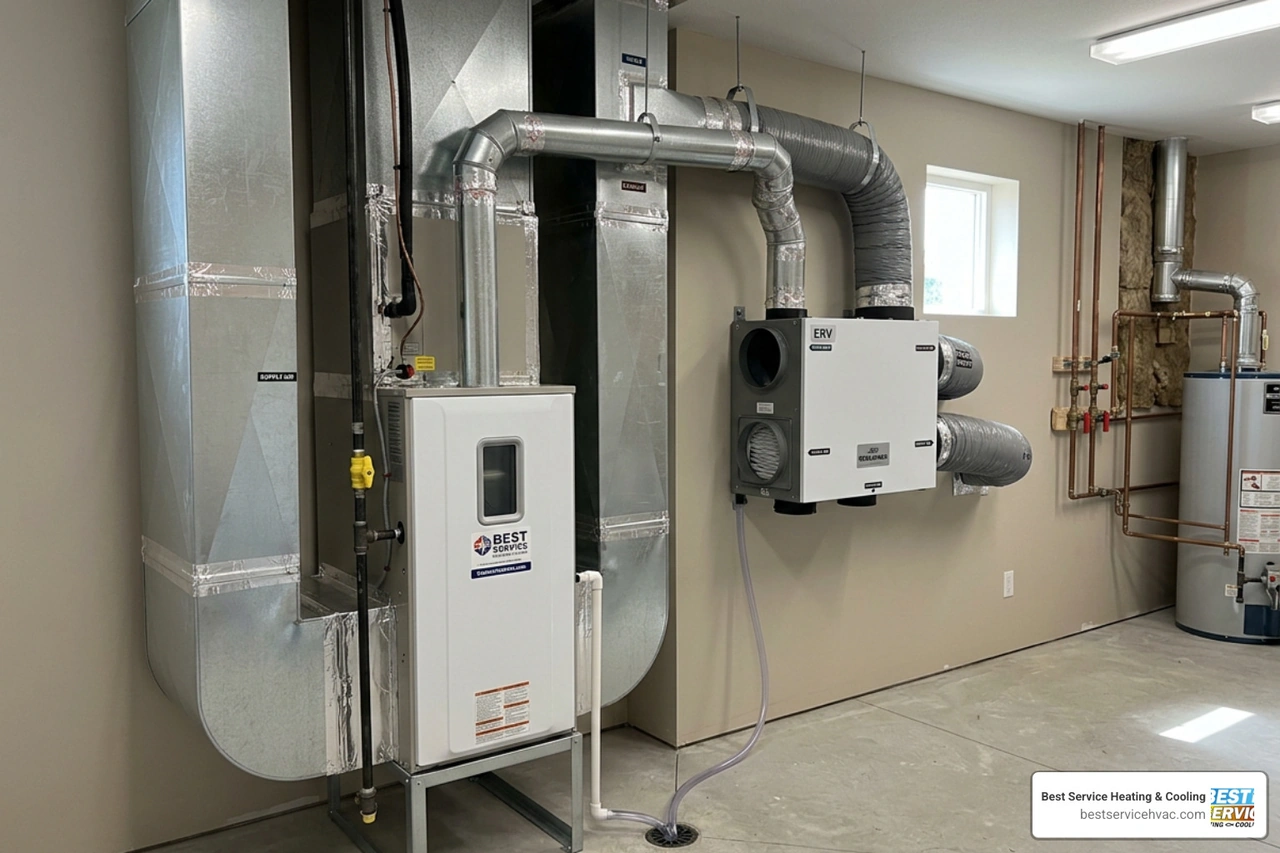
Simply opening windows is rarely practical during cold Ohio winters or humid summers. This is where mechanical ventilation systems make a massive difference:
- Heat Recovery Ventilators (HRVs): Best suited for colder climates, HRVs exhaust stale indoor air while drawing in fresh outdoor air, preheating the incoming stream using heat recovered from the outgoing air.
- Energy Recovery Ventilators (ERVs): Ideal for mixed-humid climates like Central Ohio, ERVs transfer both heat and moisture between the air streams. In the summer, it keeps outdoor humidity from entering your home; in the winter, it retains comfortable indoor moisture.
By utilizing these systems, you can achieve the fresh-air benefits of an open window without wasting energy or overloading your heating and cooling equipment. Learn more about these solutions through our specialized Ventilation HRV Services Columbus OH and Ventilation ERV Services Columbus OH.
Advanced IAQ Upgrades and Maintenance Best Practices
While high-quality filtration and ventilation keep air moving and clean, advanced indoor air quality products can actively neutralize pathogens before they ever reach your living spaces.
One of the most effective upgrades is the installation of ultraviolet (UV) germicidal lights. Positioned inside your system's ductwork near the indoor AC evaporator coil, UV Coil Purifiers Columbus OH emit UV-C light that disrupts the DNA of mold, bacteria, and viruses. Because evaporator coils are dark and damp, they are prime real estate for biological growth; UV-C lights keep these coils sterilized, improving both your air quality and your system's heat transfer efficiency.
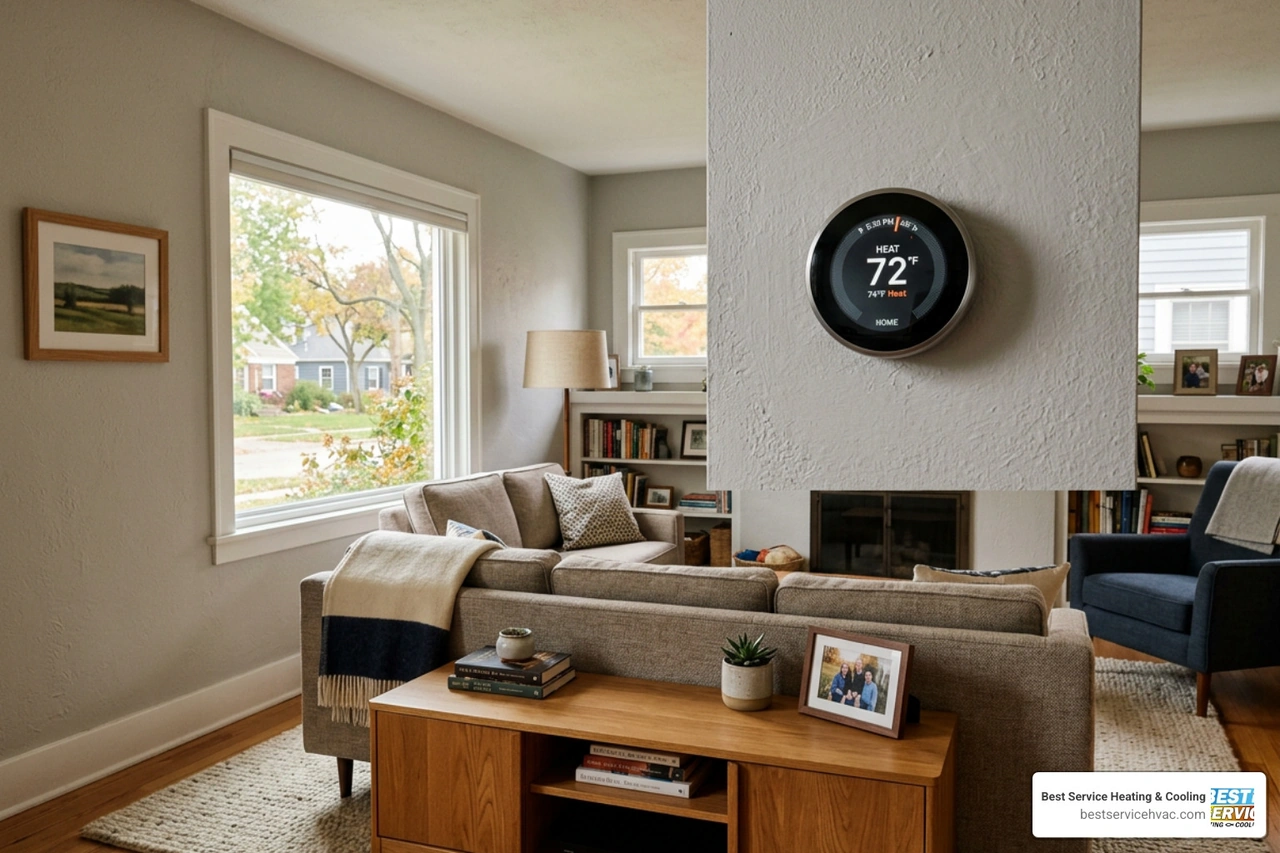
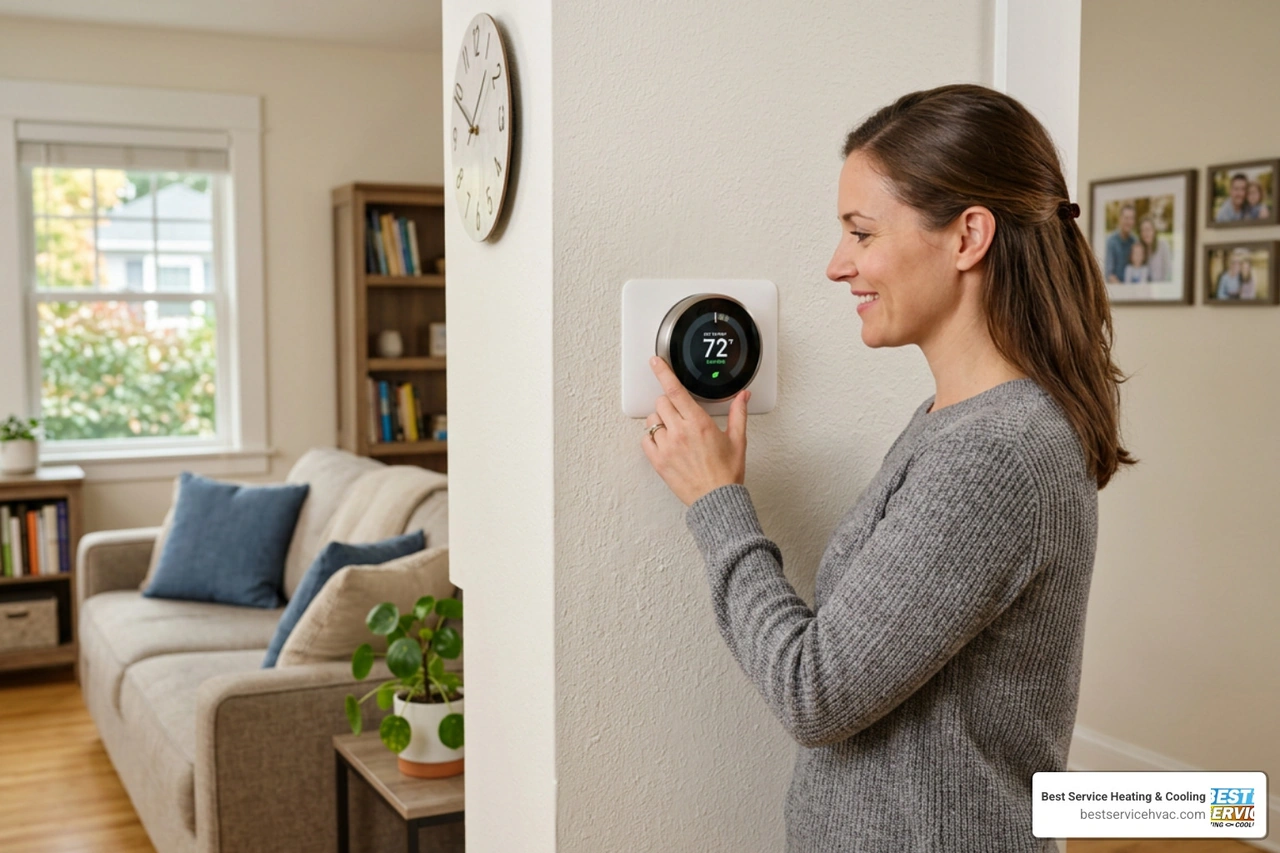
To maximize these upgrades, precise control is essential. Upgrading to Smart Thermostats Columbus OH allows you to program circulation cycles, monitor humidity levels, and receive filter replacement reminders. Proper system runtime and airflow balance are key to maintaining healthy air, as detailed in our guide on AC Efficiency Maintenance and Smart Thermostats.
If you want the ultimate level of protection against microscopic allergens and airborne viruses, a Columbus Whole House Air Purifier can be integrated directly into your central HVAC system to actively sanitize the air throughout your entire home.
Comparing Residential and School HVAC Systems
The way how your HVAC affects indoor air quality in a residential setting is fundamentally different from how it operates in commercial settings, particularly in schools.
While a home HVAC system typically manages low occupancy rates and focuses heavily on air recirculation and thermal comfort, school HVAC design is governed by stricter standards like ASHRAE 62.1. Classrooms have incredibly high occupancy densities—often 30 or more people in a single room—which means carbon dioxide and airborne pathogens can build up rapidly.
To combat this, school systems require a minimum of 15 CFM of outdoor air per person. This means a typical classroom requires at least 450 CFM of continuous fresh outdoor air to maintain healthy $CO_2$ levels and keep students focused. Commercial systems also rely on larger, multi-stage air handlers, dedicated exhaust systems for restrooms and science labs, and strict zoning controls to prevent the cross-contamination of air between rooms. Homeowners and local facility managers alike can explore these critical differences in our detailed look at Enhanced IAQ in Commercial Settings.
Frequently Asked Questions About HVAC and IAQ
How can I test and monitor my home's indoor air quality?
The easiest way to track your air quality is by using a digital desktop IAQ monitor, which measures real-time levels of $PM_{2.5}$ (fine particulate matter), $CO_2$, chemical volatile organic compounds (VOCs), and relative humidity. Additionally, because Central Ohio has areas with elevated radon potential, we highly recommend performing a dedicated radon test on your home's lowest living level. Always ensure you have working carbon monoxide (CO) detectors installed on every floor of your house.
Does running the HVAC fan continuously improve air quality?
Yes, setting your thermostat fan to "ON" instead of "AUTO" provides continuous air circulation, meaning your air is constantly passing through your high-efficiency filter even when the system isn't actively heating or cooling. This is highly beneficial during high-allergy seasons. However, keep in mind that continuous fan operation will load your air filter two to three times faster, requiring more frequent replacements, and will slightly increase your monthly electricity usage.
Is duct cleaning necessary for improving indoor air quality?
According to the EPA, routine duct cleaning has not been proven to prevent health problems. However, duct cleaning is highly recommended if you have visible mold growth inside the hard surfaces of your ducts, evidence of rodent or insect infestation, or if your registers are releasing visible dust and debris into your rooms (which often happens after a major home renovation project).
Conclusion
At the end of the day, your heating and cooling system does far more than just control the temperature on your thermostat. From filtering out microscopic dust and pollen to balancing humidity and venting stale air, your HVAC system is the single most important factor in your home's overall health and comfort.
Since 1992, Best Service Heating & Cooling has been the family-owned, trusted choice for residential HVAC services across Columbus, Ohio, and surrounding communities like Reynoldsburg, New Albany, and Grove City. With our A+ BBB rating, our trained technicians are always ready to help you find the perfect balance of comfort and clean air. If you are ready to breathe easier, explore our full line of advanced IAQ Products or contact us today to schedule your home air quality assessment!

.webp)
.webp)

Service Areas
