
The Great Debate of Tankless vs Tank Water Heaters

Why the Tankless vs Tank Water Heater Comparison Matters for Central Ohio Homeowners
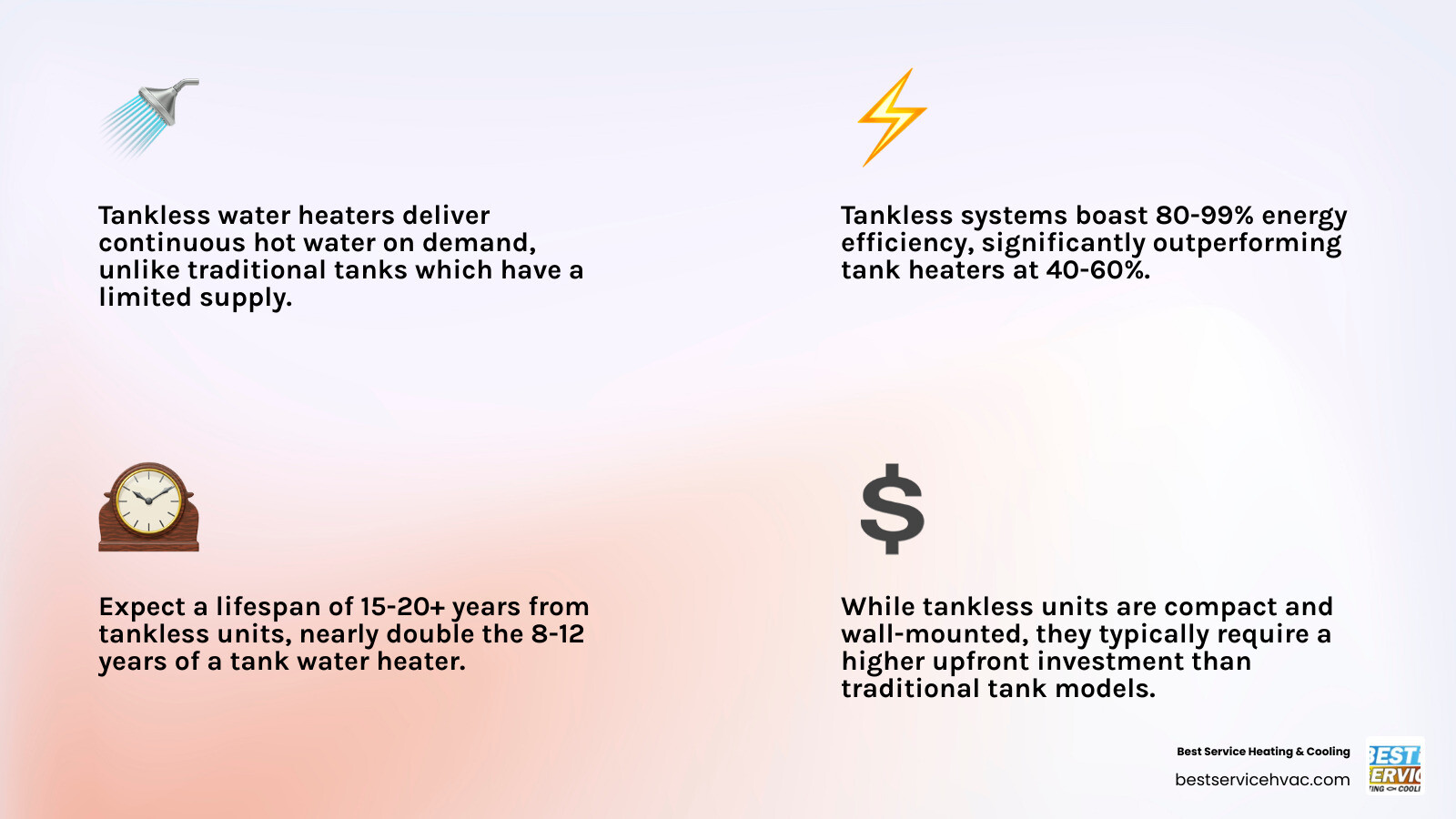
A tankless vs tank water heater comparison comes down to a few key factors: how much hot water your household uses, your upfront budget, and how long you plan to stay in your home.
Here's a quick breakdown to help you decide:
| Factor | Tank Water Heater | Tankless Water Heater |
|---|---|---|
| Hot Water Supply | Limited by tank size | Continuous, on-demand |
| Energy Efficiency | 40–60% efficient | 80–99% efficient |
| Lifespan | 8–12 years | 15–20+ years |
| Upfront Cost | Lower | Higher |
| Space Required | Large footprint | Wall-mounted, compact |
| Best For | High simultaneous demand, lower budgets | Energy savings, long-term value |
For most Central Ohio homeowners, the choice isn't one-size-fits-all. A tank heater stores and continuously heats a set supply of water — typically 30 to 80 gallons — which means it's ready the moment you turn on the tap. The downside? Once that supply runs out, you wait. A tankless unit skips the storage entirely and heats water only when you need it, which eliminates standby heat loss and keeps hot water flowing as long as demand continues.
Water heating accounts for roughly 20% of a home's total energy use. That's a significant chunk of your monthly utility bill — and the type of system you choose plays a direct role in how much you spend year after year.
In Central Ohio, groundwater temperatures can dip close to 40°F in colder months. That matters for tankless performance, and it's one of the local factors worth understanding before you make a decision.
Understanding the Tankless vs Tank Water Heater Comparison
When we look at a tankless vs tank water heater comparison, we aren't just looking at two different boxes in your basement; we’re looking at two completely different philosophies of home comfort. One relies on a "just in case" reservoir, while the other functions on a "just in time" delivery system.
For decades, the traditional storage tank was the only game in town. It’s a simple, reliable technology. However, as we move through April 2026, more homeowners in areas like Clintonville and Worthington are asking if the modern, high-efficiency tankless route is the better investment for their families.
Operational Mechanics: Tankless vs Tank Water Heater Comparison
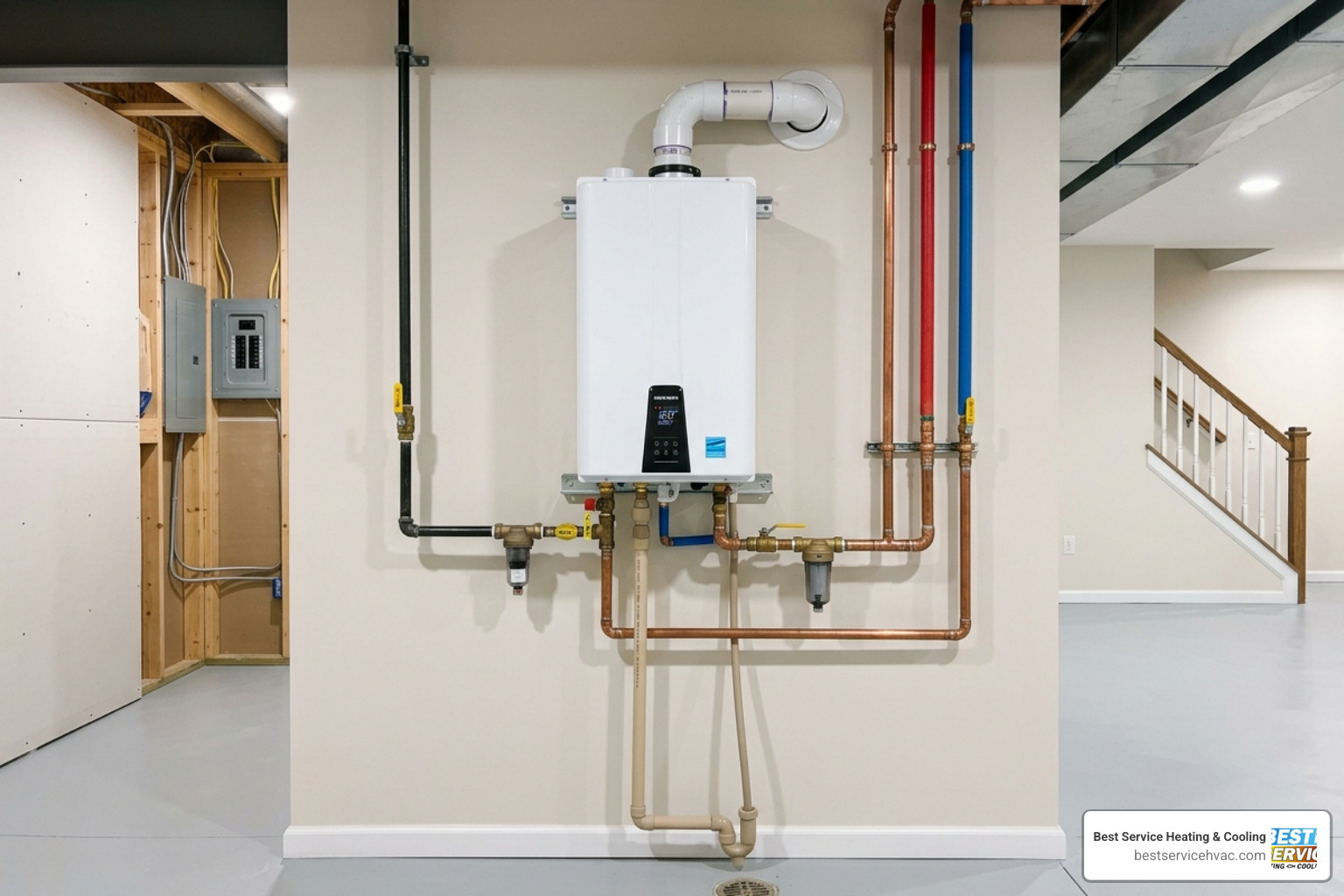
To understand which is right for you, we have to look under the hood. A traditional Water Heater with a tank works by keeping a large volume of water at a set temperature 24 hours a day. Whether you are sleeping, at work in Downtown Columbus, or on vacation, that tank is burning fuel to keep that water hot. This leads to what we call "standby heat loss."
In contrast, a tankless unit remains idle until you turn on a hot water tap. At that moment, cold water flows into the unit, where a powerful burner assembly or electric element engages. The water passes through a heat exchanger—a series of coils that transfer heat to the water instantly. By the time the water exits the unit, it has reached your desired temperature. This "on-demand" style is why many consider Tankless Water Heaters The Smart Choice for modern efficiency.
Efficiency and Supply: Tankless vs Tank Water Heater Comparison
The efficiency gap between these two technologies is one of the most compelling parts of the tankless vs tank water heater comparison. Traditional tank heaters are generally 40% to 60% efficient. This means a significant portion of the energy you pay for is literally going up the vent stack or being lost through the walls of the tank.
Tankless models, particularly condensing versions, can reach efficiency ratings of 80% to 99%. Because they only heat water when needed, they can reduce water-heating energy costs by 24% to 34% for homes that use about 41 gallons of hot water daily. Even in high-usage homes (around 86 gallons per day), they remain 8% to 14% more efficient than their tank counterparts. For a family of four in a place like Bexley or Upper Arlington, this can add up to hundreds of dollars in savings over the unit's lifespan.
When it comes to supply, the Traditional Vs Tankless Water Heater For Home debate often centers on the "endless shower." With a tank, once you’ve used those 50 gallons, the next person in line is getting a cold surprise. With a properly sized tankless unit, the hot water keeps coming as long as the tap is open.
Performance and Household Suitability in Central Ohio
Choosing the right system requires a look at your specific lifestyle. Do you have a house full of teenagers in Dublin who all need to shower before school? Or are you a retired couple in Grove City who staggers their laundry and dishwashing?
| Performance Metric | Traditional Tank | Tankless (On-Demand) |
|---|---|---|
| Simultaneous Use | Excellent (until tank is empty) | Depends on GPM rating |
| Recovery Time | 60–120 minutes | Instantaneous |
| Flow Rate | High (limited by pipe size) | 2–5 Gallons Per Minute (GPM) |
| Consistency | Steady temperature | May have "cold water sandwich" effect |
One of the biggest Factors When Replacing Your Old Water Heater is understanding how many "points of use" you need at once. A typical shower uses 2.5 GPM, and a dishwasher uses another 2 to 3 GPM. If your tankless unit is rated for 5 GPM, you can comfortably do both. If you add a load of laundry, you might start to feel the temperature dip.
Impact of Cold Inlet Temperatures
This is where our Central Ohio climate plays a starring role. In the winter, the water entering your home from the city lines can be as cold as 40°F. To get that water to a comfortable 120°F shower temperature, the heater has to raise the temperature by 80 degrees.
This "temperature rise" impacts the flow rate of tankless units. A unit that provides 7 GPM in Florida might only provide 4 GPM during a Columbus winter. This is why professional sizing is so important for a Tankless Water Heater Grandview Oh installation. We ensure the unit has enough "BTU punch" to handle our local cold snaps without leaving you with a lukewarm shower.
Space Constraints and Safety
If you live in a home with a small utility closet or a finished basement in German Village, space is at a premium. A traditional tank is a bulky cylinder that takes up significant floor space. A tankless unit is about the size of a carry-on suitcase and mounts directly to the wall, freeing up several square feet of floor space.
Safety is another critical factor in the tankless vs tank water heater comparison. Statistics show that nearly 75% of tank heaters eventually burst or leak, often spilling 30 to 80 gallons of water into the home. Because tankless units don't store water, the risk of a catastrophic flood is significantly lower. Furthermore, many modern units include advanced sensors that monitor for Warning Signs Your Water Heater Needs Repair, such as scale buildup or venting issues, and will shut down automatically to prevent damage.
Longevity and Maintenance Requirements for 2026
When we look at the long-term value of your investment, longevity is the headline. A traditional tank heater is under constant stress from heat and internal pressure. Most only last 8 to 12 years. Tankless units, however, are designed with replaceable parts and can easily last 20 years or more with proper care.
Hard Water Challenges in Columbus
Central Ohio is known for its hard water. Over time, calcium and magnesium minerals can settle at the bottom of a tank, creating a layer of "rock" that makes the heater work harder and eventually causes the tank to fail. This is Why Regular Water Heater Service Is Important.
For tankless owners, these minerals can coat the heat exchanger, reducing efficiency and eventually overheating the unit. In areas like Powell or Lewis Center, we often recommend a scale guard or a water softener to protect your investment. A Tankless Water Heater Powell Oh requires an annual descaling—a simple process where we flush the unit with a food-grade solution to dissolve mineral buildup.
Expected Service Life
While a tankless unit requires a higher initial investment, it often pays for itself through its extended lifespan. If you have to replace a tank heater twice in the time it takes to replace a tankless unit once, the "cheaper" option starts to look a lot more expensive.
Most tank heaters come with a 6-year warranty, whereas high-quality tankless models often carry 10- to 15-year warranties on the heat exchanger. For homeowners looking for a Tankless Water Heater Worthington Oh, this long-term peace of mind is often the deciding factor.
Frequently Asked Questions about Water Heater Options
Is a tankless water heater better for filling a large soaking tub?
Yes! If you have a large soaking tub in a new addition, a traditional 50-gallon tank might run out before the tub is even half full, leaving you to wait an hour for the water to reheat. A tankless unit will provide a continuous stream of hot water until the tub is full, making it the superior choice for luxury bathrooms.
How often does a tankless system require maintenance in hard water areas?
In Central Ohio, we generally recommend a professional flush and descaling once a year. If you have a whole-home water softener, you might be able to extend that to every two years, but regular check-ups ensure the sensors and burners are operating at peak efficiency.
Can a tankless unit handle multiple showers at once in cold climates?
Yes, provided it is sized correctly for the "winter delta." In our region, a high-output tankless unit can typically handle two to three simultaneous showers even when the groundwater is 40°F. During our consultation, we calculate your peak demand to ensure you never have to "schedule" your showers.
Conclusion
The tankless vs tank water heater comparison doesn't have a universal winner—it only has the right choice for your home. Whether you prioritize the lower upfront cost of a traditional tank or the "endless" hot water and energy savings of a tankless system, the team at Best Service Heating & Cooling is here to help.
As a family-owned business trusted since 1992, we understand the unique needs of Central Ohio homeowners. From Tankless Water Heater Installation New Albany Oh to emergency repairs in Reynoldsburg or Gahanna, our A+ BBB-rated team provides the expertise you need for optimal home comfort.
Ready to find the perfect hot water solution for your family? Give us a call today to discuss your options and experience the "Best Service" difference!
.webp)
.webp)

Service Areas
