
The Ultimate Guide to Tankless and Traditional Water Heater Options

Why Water Heater Options Tankless and Traditional Matter for Central Ohio Homeowners
Water heater options tankless and traditional are the two main choices you'll face when it's time to replace or upgrade your home's hot water system. And it's a bigger decision than most people expect — water heating accounts for up to 18% of your home's total energy use.
Here's a quick breakdown to help you compare:
| Factor | Traditional Tank | Tankless (On-Demand) |
|---|---|---|
| How it works | Stores and continuously heats water in a tank | Heats water instantly only when you need it |
| Energy efficiency | Lower (standby heat loss) | Higher (no standby loss) |
| Hot water supply | Limited by tank size | Continuous, on demand |
| Lifespan | 10–15 years | 20+ years |
| Upfront cost | Lower | Higher |
| Space required | Large floor footprint | Compact, wall-mounted |
| Best for | High simultaneous demand, tight budgets | Energy savings, space constraints, long-term value |
The right choice depends on your household size, hot water habits, available space, and budget. For many Central Ohio homeowners, the decision comes down to one core trade-off: pay less now with a traditional tank, or invest more upfront with a tankless unit and save on energy bills over time.
Both systems have real advantages — and real limitations. That's why it pays to understand exactly how each one works before you decide.
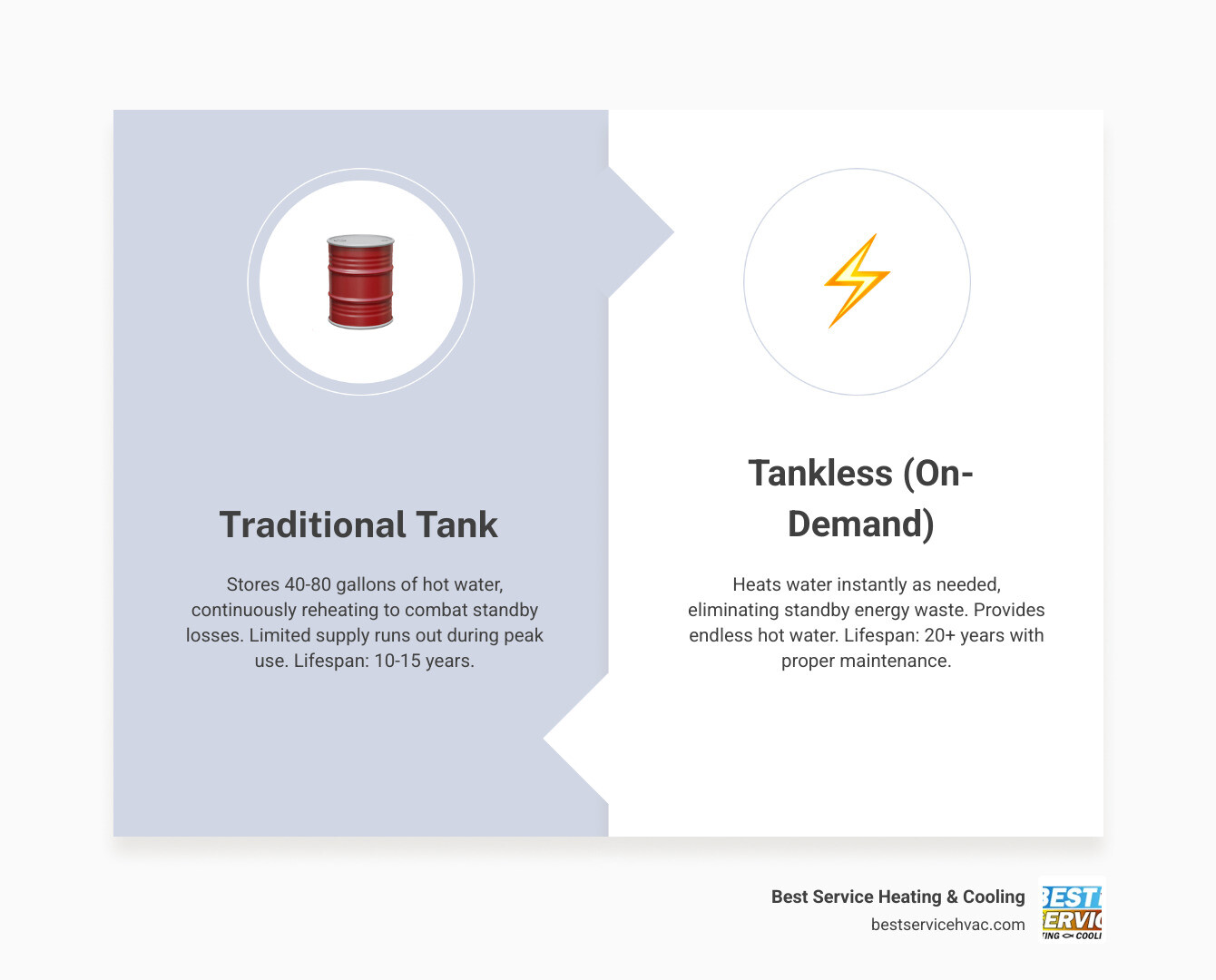
Comparing Water Heater Options Tankless and Traditional for Your Home
When we talk about water heater options tankless and traditional, we are essentially comparing two very different philosophies of home comfort. One relies on "just in case" heating, while the other focuses on "just in time" delivery.
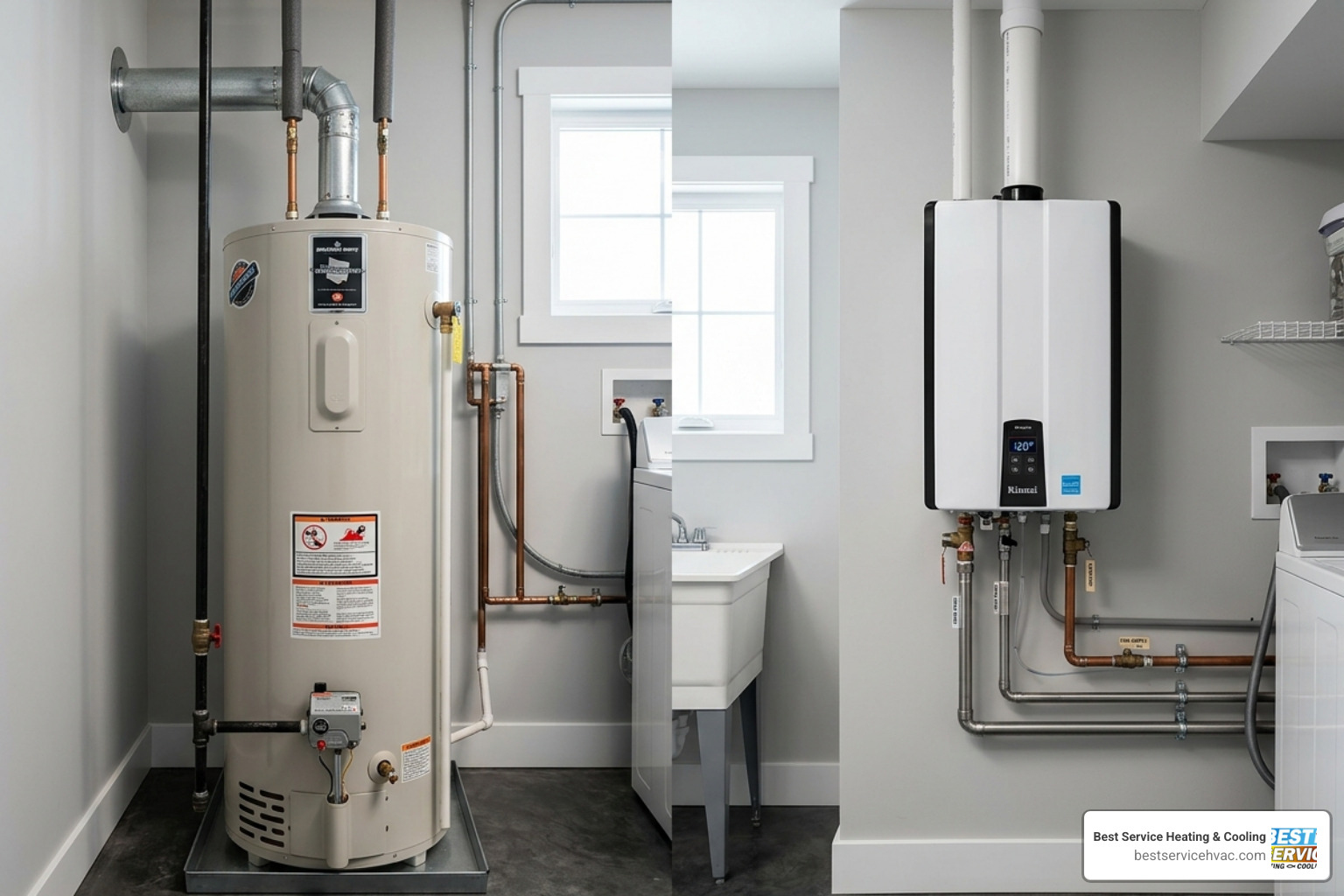
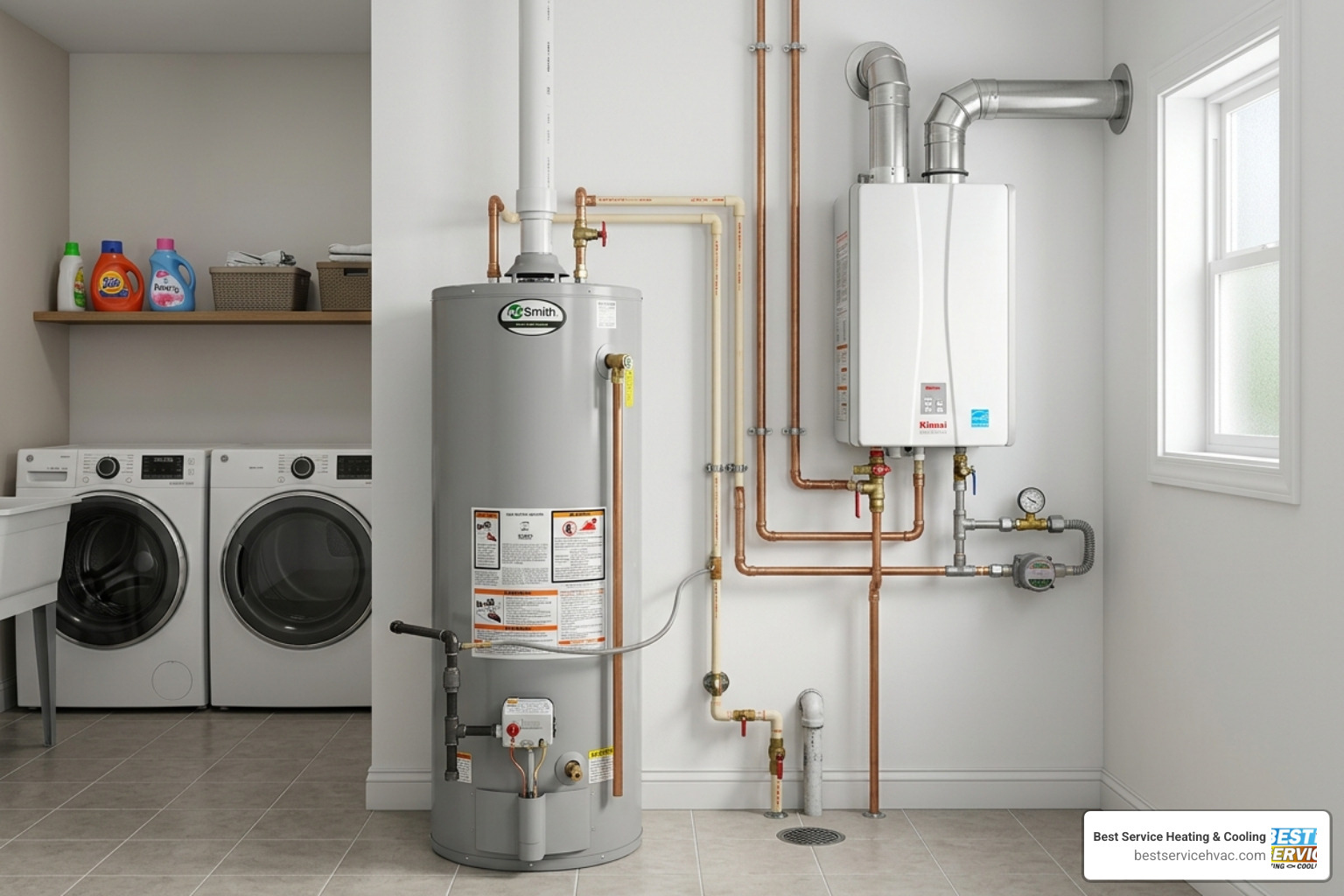
Traditional storage tank water heaters are the familiar giants we see in most basements from Dublin to Pickerington. They work by keeping a large volume of water—usually 30 to 80 gallons—at a set temperature 24 hours a day. When you turn on the hot water tap, the heated water is pulled from the top of the tank. To replace it, cold water enters the bottom, and the heating element or burner kicks on to warm it up.
The downside here is something called "standby energy loss." Even when you aren't using hot water, the tank is losing heat through its walls, forcing the system to cycle on and off just to keep that water ready for you.
On the flip side, tankless water heaters (also known as demand-type or instantaneous heaters) don't use a storage tank at all. When you turn on a hot water tap, cold water travels through a pipe and into the unit. A gas burner or an electric element heats the water instantly as it passes through a heat exchanger. This means you aren't paying to heat water while you’re at work or sleeping.
If you want a deeper dive into which logic fits your lifestyle, check out our guide on Traditional vs Tankless Water Heater for Home.
How Water Heater Options Tankless and Traditional Impact Energy Bills
In April 2026, energy efficiency is more than just a buzzword—it’s a necessity for managing household expenses. According to the Department of Energy, tankless water heaters can be 24%–34% more energy efficient than conventional storage tank heaters for homes that use 41 gallons or less of hot water daily. Even for high-demand households using around 86 gallons per day, tankless models remain 8%–14% more efficient.
The secret lies in the Uniform Energy Factor (UEF). Traditional gas tanks usually have UEFs ranging from 0.63 to 0.95. Modern Tankless Water Heater Columbus OH models often boast UEFs of 0.82 to 0.97. By eliminating standby heat loss, you’re only paying for the water you actually use.
For many of our neighbors in Central Ohio, switching to a high-efficiency model can lead to significant annual savings. While the initial investment for a tankless system is higher due to more complex installation requirements—such as potential gas line upgrades or specialized venting—the long-term reduction in utility bills often makes it the more economical choice over the unit's 20-year lifespan.
How These Systems Provide Hot Water to Your Columbus Household
The "magic" of a tankless system happens inside the heat exchanger. Think of it like a high-powered radiator in reverse. Instead of a fan blowing air over hot coils to heat a room, cold water flows through these coils while a gas burner or electric resistance element applies intense heat directly to the pipes.
In a Tankless Water Heater Gahanna OH, gas-fired models are particularly popular because they generally offer higher flow rates than electric ones. This is crucial during our cold Ohio winters when the incoming "cold" water is significantly chillier than it would be in a southern state. The heater has to work harder to raise the water temperature from 40 degrees to 120 degrees.
For those looking at a Tankless Water Heater Worthington OH, it’s important to understand "intermittent ignition devices" (IID). Older gas models used a standing pilot light, which wasted energy. Modern units use electronic ignition, ensuring the burner only fires when the sensors detect water flow.
Selecting the Best Water Heater Options Tankless and Traditional for Large Families
If you have a house full of kids, teenagers, or frequent guests, sizing is your most important consideration.
- Flow Rate: Tankless units are rated by how many gallons per minute (GPM) they can produce. A typical shower uses about 2.0 to 2.5 GPM. If you want to run two showers and a dishwasher at once, you’ll need a unit capable of at least 6-7 GPM.
- Simultaneous Demand: This is where traditional tanks sometimes have an advantage. A 50-gallon tank can dump a lot of hot water quickly, allowing for multiple simultaneous uses. However, once that 50 gallons is gone, you’re stuck with a cold shower until the tank recovers.
- Peak Usage: We often ask our Tankless Water Heater Grove City OH customers to track their "peak hour" demand. Do three people shower between 7:00 AM and 8:00 AM? If so, a tankless unit provides an endless supply, so the last person in line gets a shower just as hot as the first.
Performance, Sizing, and Efficiency for Central Ohio Families
To help you visualize the performance differences, let's look at how these systems handle a typical morning rush.
| Feature | Traditional Storage Tank | Tankless Unit |
|---|---|---|
| Recovery Time | 30–60 minutes to reheat full tank | Instantaneous (No recovery needed) |
| First Hour Rating (FHR) | High (Total gallons available in 1st hour) | N/A (Based on GPM flow) |
| Unlimited Supply? | No | Yes (As long as flow isn't exceeded) |
| Simultaneous Use | Excellent (until empty) | Good (depends on GPM rating) |
For a Tankless Water Heater Pickerington OH, we often recommend sizing the unit based on the "temperature rise" needed. In our region, we need a higher temperature rise because our groundwater gets quite cold.
If you live in a larger home, say in a Tankless Water Heater Lancaster OH, you might even consider "point-of-use" tankless units. These are small heaters installed under a sink or near a remote bathroom to provide instant hot water without waiting for it to travel all the way from the main heater.
Lifespan and Maintenance Requirements in 2026
One of the strongest arguments for tankless technology is longevity. A traditional storage tank water heater typically lasts 10 to 15 years. Eventually, the tank itself will succumb to corrosion and leak—often in a spectacular fashion that ruins your basement flooring.
Tankless models, however, are designed to last 20 years or more. Because they don't store water, they aren't as prone to the same corrosive forces as a tank. Most parts are also replaceable, meaning if a component fails, we can often fix it rather than replacing the whole unit.
However, "low maintenance" does not mean "no maintenance." In Central Ohio, we have varying levels of water hardness. Hard water can lead to scale (mineral buildup) inside the heat exchanger. If you don't descale your unit, it will lose efficiency and eventually overheat.
We recommend an annual flush and descaling. You can find more details on our Maintenance Tips for Tankless Water Heaters page. Regular check-ups are the best way to ensure your 20-year investment actually lasts 20 years. For a broader look at why we emphasize this, read about Why Regular Water Heater Service is Important.
Space Savings and Installation Considerations
If you’re tired of that big metal cylinder taking up half your utility room, you’ll love the footprint of a tankless unit. These systems are roughly the size of a carry-on suitcase and are mounted directly to the wall.
This space-saving design is a game-changer for homeowners looking at a Tankless Water Heater Powell OH who might want to convert a utility closet into extra storage or a small pantry.
However, installation is more complex than a standard tank swap. Tankless units require:
- Specialized Venting: Most gas tankless units use "direct venting" through a side wall with PVC pipe, rather than through the roof.
- Gas Line Upgrades: A tankless unit needs a massive burst of energy to heat water instantly. This often requires a larger gas line than your old tank used.
- Electrical Access: Even gas units need an electrical outlet to power the sensors and ignition system.
Before you start a DIY project, we suggest reviewing our Tips for Water Heater Installation Projects to understand the safety and code requirements involved.
Frequently Asked Questions about Water Heaters
Can I run multiple showers at once with a tankless unit?
Yes, provided the unit is sized correctly for your home's flow rate. If you have a high-capacity unit (7-9 GPM), you can easily run two showers simultaneously. However, if you try to run two showers, the dishwasher, and the washing machine all at once, you might experience a drop in water pressure or temperature. For households in Tankless Water Heater Canal Winchester OH with high simultaneous demand, we sometimes recommend installing two smaller tankless units in parallel or using a high-recovery traditional tank.
What role do heat pump water heaters play as an alternative?
Heat pump water heaters (HPWH) are a third, highly efficient option. Instead of generating heat directly, they pull heat from the surrounding air and move it into the tank—much like a refrigerator in reverse. These are incredibly efficient, with UEF ratings between 3.3 and 4.1 (that’s 330% to 410% efficiency!).
For a Tankless Water Heater Baltimore OH customer who wants the lowest possible operating costs and has the floor space for a tank, a heat pump model is a fantastic alternative. They can save a family of four about $550 per year on electric bills compared to a standard electric tank.
Are there tax incentives for high-efficiency models in 2026?
Absolutely. Under current federal standards and the Inflation Reduction Act incentives active in 2026, many homeowners qualify for significant tax credits. Energy Star certified tankless gas water heaters can qualify for credits up to $600, while heat pump water heaters can qualify for up to $2,000 (30% of the project cost).
Local utility companies in areas like Tankless Water Heater Hilltop OH also frequently offer instant rebates to encourage the switch to high-efficiency appliances. We always recommend checking the current Energy Star rebate finder before making your purchase.
Conclusion
Choosing between water heater options tankless and traditional isn't just about hot water—it's about how you want your home to function for the next decade or two. Whether you prefer the lower upfront cost and simplicity of a traditional tank or the endless supply and energy-sipping efficiency of a tankless system, the experts at Best Service Heating & Cooling are here to help.
We’ve been serving Central Ohio since 1992, and we know exactly what it takes to keep a home comfortable through every season. From sizing and selection to professional installation and long-term maintenance, we treat your home like our own.
If you're in the Bexley area and need a hand, check out our specialized Water Heaters Bexley OH - Expert Solutions from Best Service Heating & Cooling page.
Ready to make the switch or just need an expert opinion on your current system? We’re ready to help.
Schedule Your Water Heater Consultation with Best Service Heating & Cooling Today!
.webp)
.webp)

Service Areas
